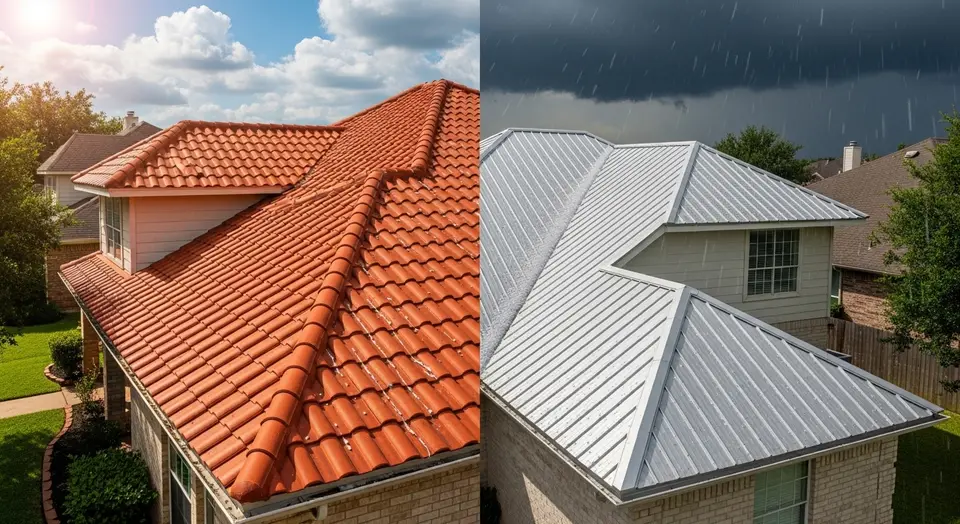
Clay Tile vs. Metal Roofing for Houston Homes — Pros, Cons & Costs
Look, I know where you’re at. You’re likely sitting at your kitchen table, maybe with a lukewarm cup of coffee, looking at a roofing estimate that made your heart skip a beat. Or perhaps you’re just tired of replacing asphalt shingles every time a tropical storm breathes on the Gulf.
In Houston, we don’t just “have weather”—we have a gauntlet. We have humidity that feels like a wet hug, sun that could fry an egg on the sidewalk by 10:00 AM, and the occasional hurricane that likes to play “pick-up-sticks” with our shingles. If you’re considering an upgrade to clay tile or metal, you’re making a smart move. These are the “forever roofs” of the South.
But choosing between them? That’s where it gets tricky. One gives your home that classic, Mediterranean River Oaks vibe, while the other looks like a sleek, modern shield. Honestly, both are great, but they serve different masters. Today, I’m going to walk you through how to choose the right one for your house, your budget, and your sanity.
What You’ll Need Before Making the Call
Before you start calling contractors, you need to do a little bit of homework. Choosing a premium roof isn’t like picking a paint color; it’s a structural decision. Here’s what you should have ready:
- A structural engineer’s opinion (Maybe): Clay tile is heavy. Like, really heavy. We’ll get into that.
- Your HOA Bylaws: Some neighborhoods in areas like The Woodlands or Sugar Land have very specific “aesthetic” rules.
- A 20-year vision: Are you staying in this house forever? Or are you moving in three years? Your answer changes everything.
- An understanding of the best roofing materials for Houston’s climate: Context is everything.
How to Choose: A Step-by-Step Breakdown
Step 1: Evaluate Your Home’s “Bone Density” (Weight)
This is the big one. Clay tile can weigh anywhere from 600 to 1,200 pounds per “square” (a 10×10 foot area). Metal, on the other hand, is a featherweight, often coming in at around 50 to 150 pounds.
If your house was originally built for shingles, it might not be able to support the literal tons of extra weight that clay tile brings. If you go with tile, you might have to pay thousands just to beef up your rafters and trusses.
Pro Tip: If you love the look of tile but your house can’t handle the weight, look into “synthetic” or “lightweight” tiles. They give you the look without the structural headache.
Step 2: Consider the “Solar Oven” Factor (Energy Efficiency)
In Houston, your roof is basically a giant solar panel that doesn’t produce electricity—it just produces heat.
Metal is a “reflective” material. It kicks the sun’s rays back into space. Clay is a “thermal mass” material. It absorbs heat slowly and releases it slowly. Both are miles better than asphalt, but metal usually wins the “lowest AC bill” trophy in our climate.
Expected Outcome: Switching from dark shingles to either of these could drop your attic temperature by 20 to 30 degrees. Imagine what that does for your electric bill in August.
Step 3: Crunch the Honest Numbers
I’m not going to lie to you—neither of these is “cheap.”
- Metal Roofing: Expect to pay somewhere between $12 and $20 per square foot for a good standing-seam system.
- Clay Tile: You’re looking at $15 to $25 per square foot, plus the potential cost of structural reinforcement.
Warning: Don’t get seduced by “cheap” metal roofing. If a contractor offers you a “screw-down” metal roof for the price of shingles, run. In Houston’s wind, you want “standing seam” where the fasteners are hidden.
Step 4: Think About the “Last Roof” Reality
A metal roof will likely last you 40 to 60 years. Clay tile can easily hit 75 to 100 years.
But here’s the “insider” secret: The tiles might last 100 years, but the underlayment (the waterproof stuff underneath) usually only lasts 30. That means with clay, you might have to pay to have the tiles removed and re-installed mid-way through its life. Metal doesn’t usually have that problem.
Visualizing the Difference
[IMAGE: A side-by-side comparison of a Houston home. On the left, a Mediterranean-style home with terracotta S-curve clay tiles, showing high texture and shadows. On the right, a modern farmhouse-style home with a matte charcoal standing-seam metal roof, showing clean vertical lines and a sleek finish.]
[IMAGE: A cross-section diagram of a metal roof installation. It should show the decking, the synthetic underlayment, and the interlocking “standing seam” panels that hide the screws from the rain.]
Troubleshooting Common Concerns
“I heard metal roofs are loud in the rain.” Honestly? Only if you live in a barn with no ceiling. On a standard house with an attic and insulation, you won’t hear a thing. I’ve actually had clients tell me they miss the sound of rain because the metal is so well-insulated.
“Will hail break my clay tiles?” It can. While clay is tough, a baseball-sized hailstone can crack a tile. Metal might get a small dent (which gives it “character,” right?), but it won’t crack or leak. If you live in a high-hail area, metal is the safer bet.
“What about the salt air?” If you’re down toward Galveston or Clear Lake, salt is the enemy. Clay tile loves salt—it doesn’t care. For metal, you must use aluminum or a high-end coated steel (like Galvalume). If you use cheap galvanized steel near the coast, it’ll be a pile of rust in ten years.
Expert Insights for Houston Homeowners
Look, I’ve seen a lot of roofs. If you’re struggling to decide, here’s my “friend-over-coffee” advice:
- Check your pitch: If your roof is relatively flat, clay tile is a bad idea. It needs a good slope to shed water. Metal can handle much flatter surfaces.
- The Insurance Hack: Call your insurance agent. Many Texas insurers give a massive discount (up to 35%) for metal roofs because they’re fireproof and hail-resistant. This can actually pay for the price difference over time.
- Color Matters: In Houston, go light. A white or “stone” colored metal roof will perform significantly better than a dark bronze one. For clay, the classic terracotta is naturally pretty “cool” compared to black shingles.
Summary & Next Steps
At the end of the day, you’re choosing between two of the best options on the market.
- Choose Clay Tile if: You have a Mediterranean or Spanish-style home, you have a sturdy foundation, and you want that “old world” prestige that never goes out of style.
- Choose Metal if: You want the absolute best energy efficiency, you want a “set it and forget it” maintenance schedule, and you want something that stands up to hurricanes like a champ.
What now? Your next move should be a “roofing interview.” Don’t just get a quote; ask the contractor how many metal or tile roofs they’ve done in the last year. These materials require specialized skills—this isn’t the time for a “jack-of-all-trades” crew.
And hey, if you’re still weighing your options, take another look at the different roofing materials for Houston’s climate to see how these stack up against high-end shingles.
You’re doing the right thing by looking into this now. A little extra spent today means you won’t be that person staring at a yellow spot on the ceiling at 3:00 AM ten years from now. You’ve got this!