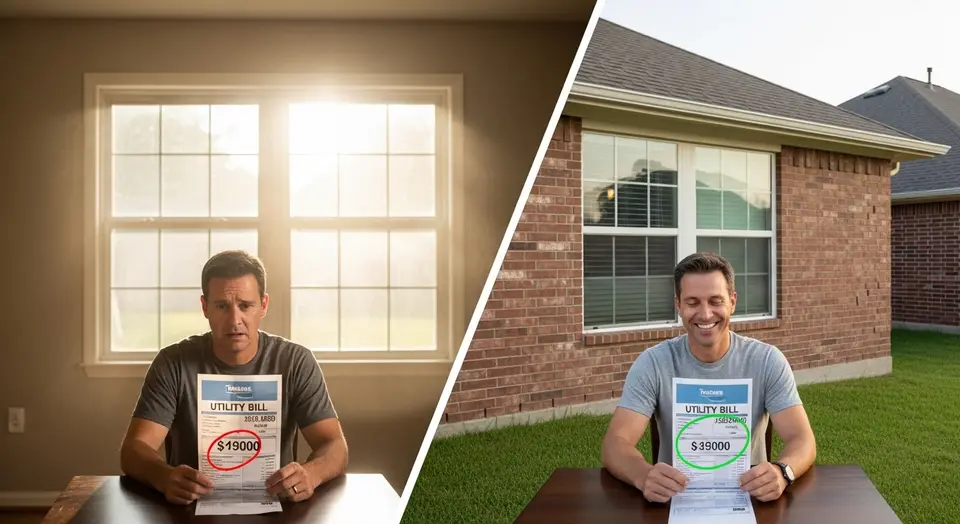
I was sitting in a friend’s living room in Conroe last August, and even with the AC humming at max volume, I could feel the heat radiating off the glass behind me. It was like the sun was reaching through the window and tapping me on the shoulder, just to remind me it was 102 degrees outside. My friend looked at me, sighed, and asked the question every Texas homeowner eventually asks: “If I drop the money on new windows, is it actually going to make a dent in this electric bill?”
Honestly, it’s a fair question. We aren’t talking about a small investment here; window replacement is a big deal. You want to know if that “investment” is just a fancy word for “expensive project” or if it actually puts money back in your pocket.
Look, I’m not here to give you a sales pitch. I want to look at the actual math of how energy efficient windows in Texas perform in our unique climate. Because let’s face it—a window that works in Minnesota is a completely different animal than what we need down here. If you’ve been wondering if your AC is working overtime because of your glass, you’re probably right. Let’s break down the five big ways the math actually checks out.
1. The “Solar Heat Gain” Equation
The biggest enemy of your wallet in Texas isn’t the air temperature—it’s the radiant heat from the sun. Think of it like a greenhouse. In the old days, windows were basically just holes in the wall with a sheet of glass. The sun hits that glass, the heat passes right through, and suddenly your living room is a sauna.
Modern new window installation uses something called Low-E (low-emissivity) coatings. It’s a microscopic metallic layer that reflects infrared light. To put it simply: it lets the light in but bounces the heat back out.
The Scenario: Imagine a West-facing bedroom that gets pounded by the afternoon sun. With old single-pane windows, that room might stay 5-8 degrees warmer than the rest of the house, forcing your AC to run 20% longer just to compensate for that one room.
Pro Tip: Look specifically at the SHGC (Solar Heat Gain Coefficient) rating. In Texas, you want this number as low as possible—ideally below 0.25.
Getty Images
2. Giving Your HVAC a Literal Break
I’ve seen so many homeowners in places like Pearland or Sugar Land replace their AC units only to find their bills are still high. Why? Because the “shell” of the house is leaky. When your windows are inefficient, your HVAC system never hits its “cutoff” point. It just chugs along, wearing out the compressor and skyrocketing your peak-demand charges.
By installing high-quality window replacement services, you’re essentially putting a better “lid” on your cooler. When the house stays cool longer, the AC cycles off. That’s where the real math happens—not just in the pennies saved per hour, but in the years added to your HVAC’s lifespan.
The Scenario: A typical 2,500-square-foot Texas home might see the AC cycle 4 times an hour in July. With high-efficiency windows, that might drop to 2 cycles. Over a decade, that’s thousands of dollars saved in potential repairs and replacement costs.
Pro Tip: Don’t just think about the monthly bill; think about the $12,000 AC replacement you’re pushing further into the future.
3. The Argon Gas Insulator Effect
You know those double-pane windows you see everywhere? The magic isn’t just in having two layers of glass. It’s what is between them. In 2026, most high-end windows are filled with Argon or Krypton gas. These gases are denser than air, which means they are terrible at conducting heat.
But here’s the “Texas Truth”: Old double-pane windows often have “blown seals.” If you see fog or moisture between your panes, that gas is gone. You’re left with regular old air that’s doing almost nothing to stop the heat. Upgrading to a fresh, sealed unit like the Energy Master Series is like upgrading from a screen door to a vault door.
The Scenario: You’re standing near a window during a “Texas Norther” (the three days of winter we get). If the glass feels ice-cold to the touch, your insulation is failed. New gas-filled windows will feel much closer to room temperature.
Pro Tip: If you see condensation inside the glass, the math is already working against you. That window is officially broken.
4. Eliminating the “Draft” Tax
We talk a lot about heat through the glass, but what about the air moving around the frame? In older homes, the wood or aluminum frames warp over time. This creates tiny gaps—sometimes so small you can’t see them—where your expensive, cooled air is escaping and the humid Texas soup is crawling in.
When we do a full exterior remodeling, we see this all the time. The framing around the window has settled, leaving gaps. Modern vinyl frames are designed to expand and contract with the heat without losing their shape, keeping that seal tight for decades.
The Scenario: On a windy day, hold a piece of tissue paper near the edge of your window frame. If it flutters, you’re literally watching dollar bills fly out of your house.
Pro Tip: Proper installation is just as important as the window itself. If the caulking and foam aren’t done right, the best window in the world won’t save you a dime.
5. Reduced Peak-Demand Charges
Texas power companies love their “Time of Use” plans. They charge you a premium when everyone else is running their AC (usually 2 PM to 7 PM). This is also when the sun is at its most brutal.
If your windows are old, your house absorbs the most heat right when electricity is the most expensive. By reflecting that heat away, you can “coast” through those peak hours without your AC kicking into overdrive. Honestly, this is the most underrated part of the math. You aren’t just using less energy; you’re using it when it’s cheaper.
The Scenario: A homeowner in The Woodlands switches to Low-E glass. During the 4 PM heat spike, their home temperature only rises 1 degree per hour instead of 3. They save $40 a month just by avoiding peak-rate surges.
Pro Tip: Check your electric bill for “Demand Charges” or “Peak Rates.” This is where the windows pay for themselves the fastest.
Window Savings At-A-Glance
| Feature | Old Single-Pane | Modern Energy-Efficient | Estimated Impact (TX Summer) |
| Glass Type | Clear Glass | Low-E / Argon Filled | 70% less heat transfer |
| Frame Leakage | High (Warped/Worn) | Tight Seal (Vinyl/Composite) | Stops “drafty” cooling loss |
| AC Strain | Constant Cycling | 30-50% Less Run Time | Extends HVAC life by years |
| UV Protection | 0% (Fades Furniture) | 90%+ (Protects Interior) | Saves rugs, floors, and art |
Key Takeaways for Homeowners
- SHGC is King: In Texas, focus on the Solar Heat Gain Coefficient over the U-Factor. Reflecting heat is more important than trapping it.
- The 20-30% Rule: Most homeowners see a 20-30% reduction in the cooling portion of their energy bill after a full replacement.
- Don’t Forget the HVAC: The secondary savings come from not having to replace your AC unit every 8 years because it’s been run to death.
- Installation Matters: A “cheap” installation will leave gaps that negate all the fancy technology in the glass.
- Rebates Exist: Many local utility providers offer incentives for Energy Star-rated windows.
Frequently Asked Questions
Conclusion: Is it Worth It?
Look, I’ll be straight with you. If you’re looking for a project that pays for itself in six months, window replacement isn’t it. The math is a long game. But if you plan on staying in your home for more than a few years, the combination of lower monthly bills, a longer-lived AC, and the sheer comfort of being able to sit by your window without sweating is worth every penny.
It’s about taking control of your environment. You shouldn’t have to live in the dark with the curtains drawn just to keep your electric bill under $400.
If you’re tired of feeling the sun through your glass and you want to see what the actual numbers look like for your specific house, reach out for a free estimate. We can walk through your home, check your current glass, and tell you exactly where you’re losing money. No pressure, just a real look at the math.
Your home is your sanctuary. Let’s make sure it actually feels like one, even when the Texas sun is doing its worst.
Ready to give your AC a break? Contact us today and let’s find the right windows for your budget and your home.