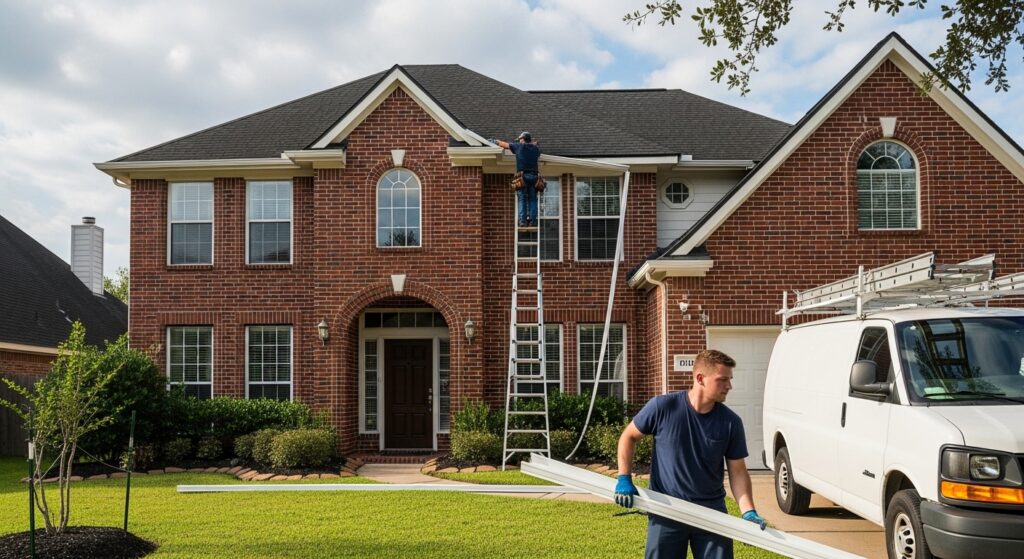

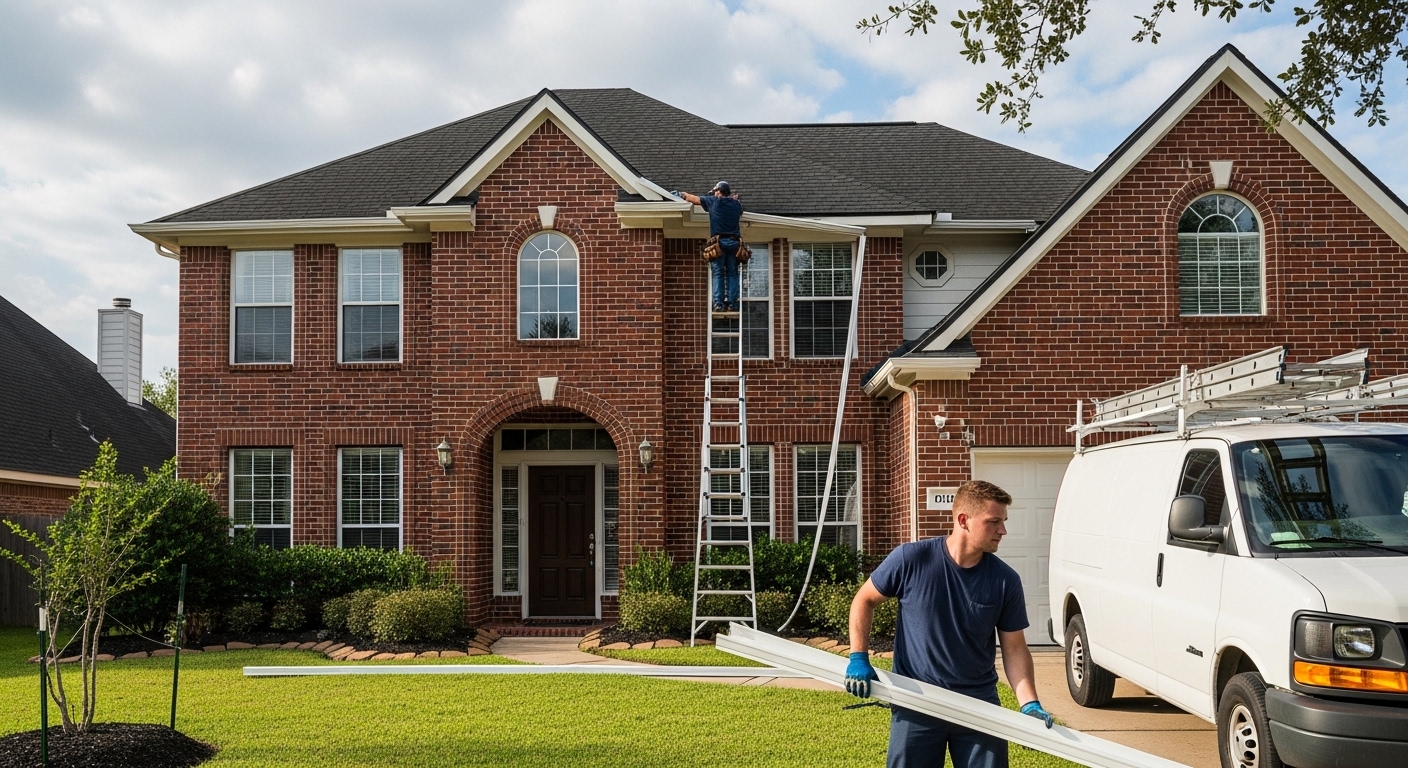
Is It Time to Let Go? Your Guide to Gutter Replacement in Houston
We’ve all been there. You’re standing in the garage, watching a literal waterfall pour off the side of your roof because the gutters just aren’t doing their job. It’s frustrating. It’s messy. And honestly, it’s a bit stressful when you think about what all that water is doing to your flower beds—or worse, your foundation.
In Houston, our rain isn’t just rain; it’s a tropical event. One minute it’s sunny, and the next, your backyard is a lake. Because of that intensity, your gutters are the unsung heroes of your home. But here’s the thing: they don’t last forever. Most homeowners spend years patching and cleaning, but there comes a point where a simple repair is just throwing good money after bad.
The goal of this guide is to help you figure out if you’re at that “point of no return.” We’re going to walk through how to audit your own system so you can decide if it’s time for a full gutter replacement. It’s about saving you from the headache of future foundation cracks and keeping your home’s “curb appeal” from looking like a swamp.
If you ever feel like the climb is too steep (literally), you can always check out our gutter and downspout services in Houston to have a set of professional eyes take a look.
What You’ll Need for the “Gutter Audit”
Before we dive into the steps, don’t worry—you don’t need a degree in engineering. You just need a few basic things and a bit of a “detective” mindset.
- A sturdy ladder: Safety first. Please. Make sure you have someone to spot you or that the ladder is on level ground.
- A pair of work gloves: Gutters are surprisingly sharp and, let’s be real, pretty gross inside.
- A garden hose: This is for the “simulated rain” test.
- About 45 minutes of time: Best done on a day when it isn’t actually raining so you can see the dry evidence first.
- A phone camera: To document the “crime scenes” you find up there.
Step-by-Step: Diagnosing the Need for Gutter Replacement
Step 1: Walk the Perimeter and Look Down
Believe it or not, the best clues aren’t in the air—they’re on the ground. Walk around your house and look at the soil and the siding right where the gutters hang.
Are there “trenches” in the mulch? Do you see green or black staining on your siding? This is a classic sign of “overshoot” or leaking seams. In our Houston humidity, that moisture sitting against your walls is an open invitation for rot. If you see peeling paint on the underside of the gutters, that’s water that has been sitting there far too long.
Pro Tip: Look for “orange” spots in the dirt. That’s often rust from old galvanized steel gutters that are literally disintegrating from the inside out.
Step 2: The “Count the Cracks” Inspection
Climb up (carefully!) and look into the troughs. Small cracks can be fixed with a bit of sealant. But if you start seeing a dozen little splits, or if a seam has completely pulled apart, a repair is just a Band-Aid.
Look, I’ve seen people try to use waterproof tape and buckets of caulk to save an old system. Honestly? It rarely works for more than a few months. When the structural integrity of the metal is gone, it’s gone.
Step 3: Check the “Lean” and the Sag
Gutters are supposed to be pitched perfectly toward the downspouts. If you see them sagging in the middle like a tired clothesline, the hangers might be stripped out.
But here is the scary part: sometimes the gutters sag because the wood behind them (the fascia) is rotting. If the wood can no longer hold the weight of a heavy rain, you aren’t just looking at gutter work; you might need some reliable roof repairs in Texas to fix the underlying structure.
Warning: If you can pull the gutter away from the house with one finger, get down from the ladder. That thing is a falling hazard.
Step 4: The Simulated Rain Test
Grab your hose and run water into the gutter at the furthest point from the downspout. Watch the flow. Does it move quickly? Or does it pool up in the middle?
If the water pools, the gutters have likely warped over time due to our intense Texas heat. Heat expansion and contraction can “bow” the metal, making it impossible for water to ever drain correctly again. This is a primary driver for a full gutter replacement.
Expected Outcome: You want to see the water clear the downspout within seconds. If it’s a slow crawl, you’ve got a slope issue that usually requires a total re-install.
Step 5: Check the Foundation and Basements (or Crawlspaces)
In Houston, we don’t have many basements, but we have plenty of “slab-on-grade” foundations. If you see water pooling right against your concrete slab, that water is seeking a way under your house.
I’ve talked to many homeowners who ignored their gutters for years only to end up with $20,000 foundation repair bills. It’s heartbreaking because a simple gutter upgrade could have prevented it.
Visual Indicators to Watch For
To help you visualize what “bad” looks like, here are the three big ones:
- The “Tiger Stripes”: Vertical dark streaks on the front of the gutter. This means water is constantly overflowing and taking dirt with it.
- Daylight through the Bottom: If you can see the sky through the bottom of your gutter while standing on the ground, it’s over. Metal doesn’t heal.
- The “Pillow” Effect: If your downspouts look swollen or have burst seams, they likely froze or got backed up so badly that the pressure deformed the metal.
Troubleshooting Common “Maybe” Situations
Sometimes, it’s a toss-up. Here’s how to decide:
- “It’s just one leak at the corner”: This is a repair. Clean it out, dry it, and apply a high-quality gutter sealant.
- “The downspout fell off”: This is usually a repair. New straps and some zip screws can often save it.
- “I have five leaks and the gutters are 20 years old”: This is a gutter replacement. Modern seamless aluminum gutters are much more durable and won’t leak like the old sectional ones.
- “There’s a tree growing in it”: That’s a cleaning issue! But check for root damage to the seams once you get the forest out of there.
Expert Insights for Houston Weather
Since we deal with high wind and heavy rain, I always recommend seamless gutters over the stuff you buy in sections at the big-box stores. Every seam is a potential leak point. In a Houston downpour, a seamless system handles the volume so much better.
Also, think about the size. Standard 5-inch gutters are okay, but for many of the large roof spans we see in Harris County, upgrading to 6-inch “K-style” gutters can be a lifesaver. It’s like upgrading from a straw to a firehose.
If you’re already considering a roof replacement in Harris County, that is the absolute best time to do your gutters. The crews are already there, and the staging is set. It’s much more cost-effective.
Summary & Your Next Steps
Let’s recap the “Red Flags”:
- Water marks or rot on the fascia boards.
- Persistent foundation puddles or soil erosion.
- More than three or four distinct leaks or holes.
- Gutters that “pull away” from the house no matter how much you tighten them.
Look, I know a gutter replacement isn’t the most glamorous home project. It’s not a kitchen remodel or a new deck. But it is the “insurance policy” for your home’s skeleton. Honestly, there’s a certain peace of mind that comes with sitting on your porch during a storm and hearing the water go exactly where it’s supposed to go.
What should you do now?
- Do the walk-around: Check your siding and soil today.
- Get a pro opinion: If you saw any of the “Red Flags,” don’t wait for the next hurricane season.
- Explore your options: Take a look at exterior services in Harris County to see what modern systems look like.
You’ve worked hard for your home. Don’t let a few pieces of bent metal and a little bit of rain take it away from you.
Would you like me to find some local Houston gutter color trends that match your specific style of siding?