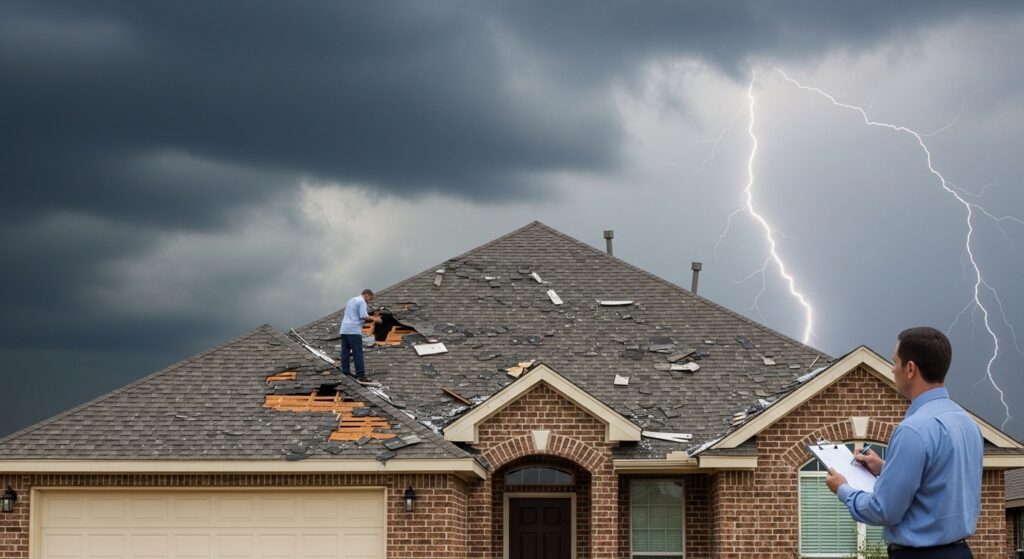

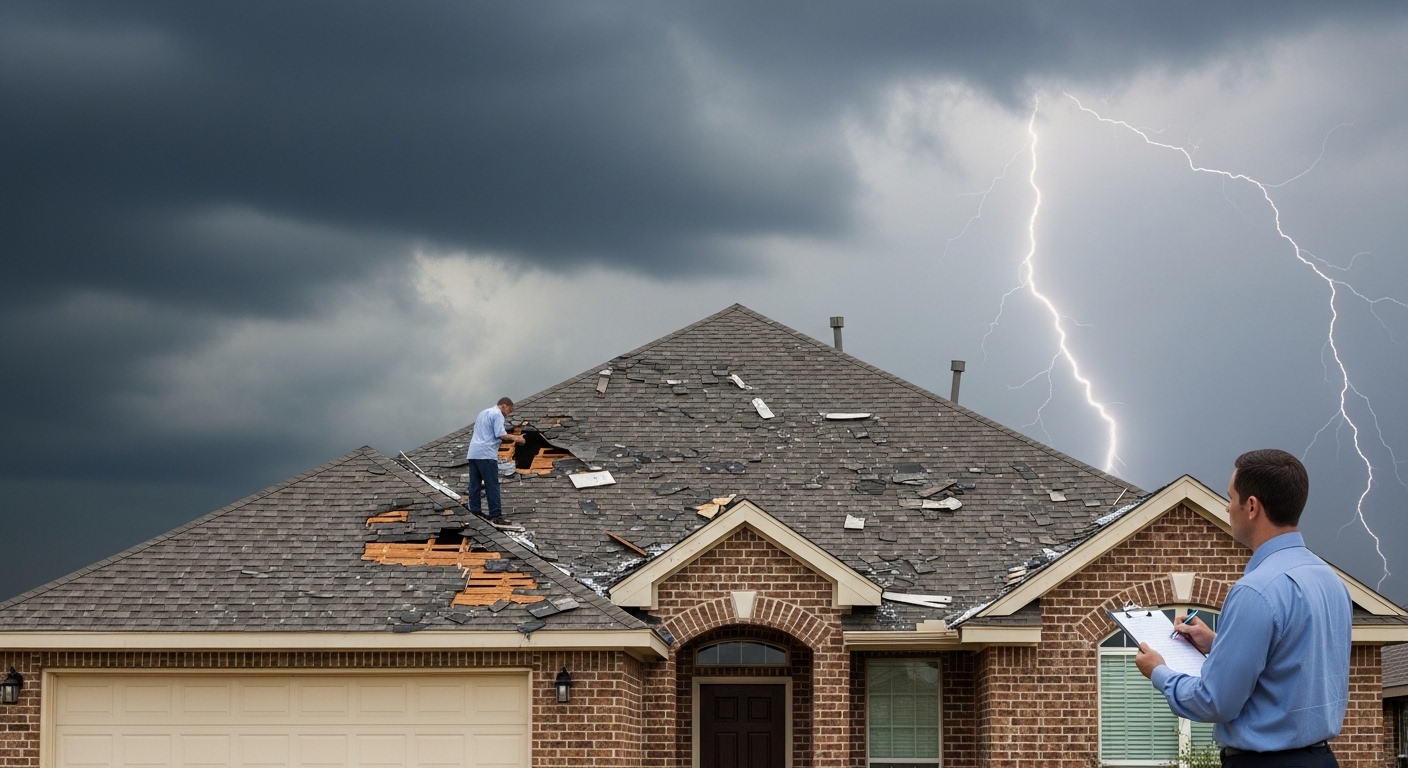
If you’ve lived in Texas for more than a single spring, you know the routine. The sky turns that weird, bruised shade of green, the sirens start wailing, and suddenly it sounds like someone is dumping a bucket of golf balls onto your roof. Once the sun comes back out, every homeowner in the neighborhood is out on their lawn, squinting at their shingles and asking the same high-stakes question: Is my insurance going to pay for this?
Navigating insurance in the Lone Star State can feel like trying to read a map in a hurricane. Between the high deductibles and the fine print about “actual cash value” versus “replacement cost,” it’s easy to feel like the system is rigged against you.
But here’s the thing: your policy is a contract, and in Texas, we deal with enough “acts of God” that the rules for roof damage are actually pretty well-defined. You just need to know how to play the game. Whether you’re dealing with hail, wind, or a fallen oak tree, I’m going to walk you through exactly how to handle a claim so you don’t end up footing a $20,000 bill alone.
Prerequisites: What You Need Before You Call
Before you pick up the phone to call your agent, you need to have your ducks in a row. Insurance companies are looking for reasons to say “no,” or at least “not that much.” You want to make it impossible for them to look away.
- Your Declarations Page: This is the “cheat sheet” at the front of your policy. Look specifically for your Wind/Hail Deductible. In Texas, this is usually a percentage (1% or 2%) rather than a flat dollar amount.
- A “Pre-Storm” Reference: If you have photos of your roof from last year, find them. It’s much harder for an adjuster to claim “wear and tear” if you can show the roof was in great shape six months ago.
- A Trusted Roofer’s Number: Do not—I repeat, do not—file a claim before having a professional roofer look at the damage. You want an advocate who knows what hail actually looks like, not just someone who wants to sell you a patch.
The Step-by-Step Guide to Navigating a Texas Roof Claim
1. Document the “Event” and the Immediate Damage
Insurance coverage in Texas is trigger-based. They don’t cover a roof just because it’s old; they cover it because something happened.
Take photos of the hail on the ground (use a coin or a ruler for scale). Take photos of any downed limbs or missing shingles you can see from the safety of the yard. If there’s a leak inside, take a video of the drip. This creates a “date of loss,” which is the most important piece of data for your claim.
Pro Tip: If you see shingles curling or cracking after a storm, don’t assume it’s just old age. Sometimes the wind lifts the shingle just enough to break the seal, causing it to warp.
2. Get a Professional “Damage Assessment”
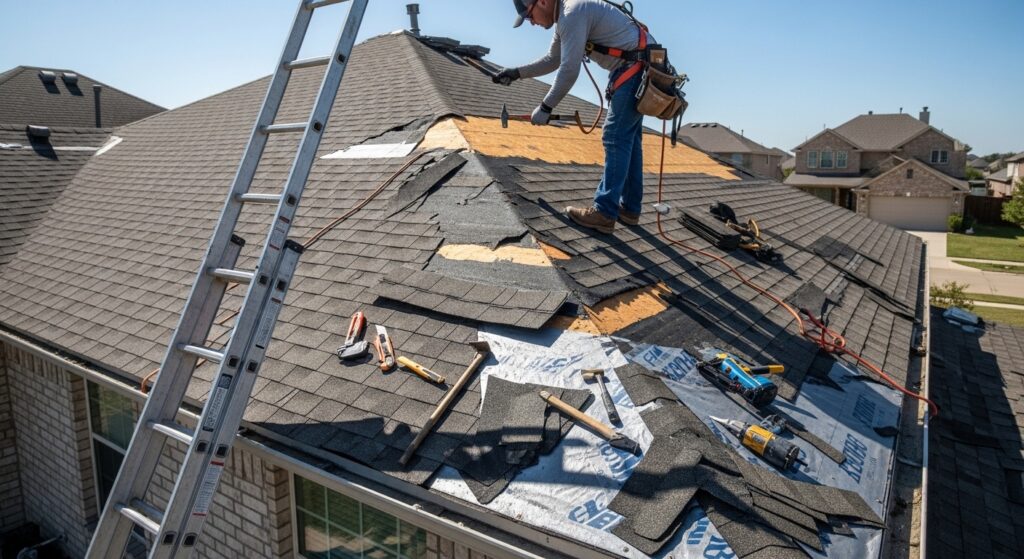
Call a local roofing pro. Most reputable Texas roofers offer free inspections after a storm. They’ll get up on the roof (so you don’t have to) and look for “bruising”—those spots where hail hit the shingle so hard it broke the fiberglass mat underneath.
Expected Outcome: Your roofer should give you a digital photo report showing exactly what they found. If they say, “Yeah, you’ve got enough hits for a claim,” then you move to step three. If they say it’s just minor wear, you save yourself the “claim strike” on your insurance record.
3. File the Claim and Prep for the Adjuster
Once you file, the insurance company will send out an adjuster. Here’s the “Texas Truth”: Adjusters are human. They’re often overworked after a big storm, and they might miss things.
Ask your roofer to be present when the adjuster arrives. It’s not about being confrontational; it’s about making sure two sets of eyes see the same damage. Your roofer can point out things the adjuster might overlook while checking 15 other houses that day.
4. Understand Your Payout (ACV vs. RCV)
This is where most homeowners get confused and frustrated.
- RCV (Replacement Cost Value): The “good” one. They pay what it costs to replace the roof at today’s prices. They’ll send a first check (minus your deductible and depreciation), and then a second check once the work is done to “recover” that depreciation.
- ACV (Actual Cash Value): The “tough” one. They take the cost of a new roof and subtract the “age” of your current roof. If your roof is 15 years old, they might only pay 50% of the cost.
Warning: Check your policy for a “Roof Surface Payment Schedule.” Some Texas insurers are moving to ACV-only for roofs older than 10 years to save money.
Visualizing the Process
[IMAGE: A flowchart showing the claim lifecycle: Storm Event -> Roofer Inspection -> Claim Filing -> Adjuster Meeting -> Payout 1 (Materials) -> Roof Install -> Payout 2 (Depreciation)]
[IMAGE: A close-up photo of hail damage on an asphalt shingle. It shows a “bruise” where granules are missing and a circular indentation, contrasted with a “normal” worn shingle.]
Troubleshooting Common Insurance Roadblocks
“They denied my claim because of ‘Wear and Tear’.” This is the most common denial in Texas. If your roof is old, the insurance company will try to say the shingles were already failing. This is why having a roofer who can show “directional” damage (damage that only appears on the side of the house hit by the wind) is so critical. You can appeal a denial, but you’ll usually need a second inspection or an “appraisal” process.
“My deductible is $6,000, but the repair is only $4,000.” In this case, you don’t have a claim. This is why percentage deductibles are so tricky. If your home is insured for $400,000 and you have a 2% deductible, you’re on the hook for the first $8,000. In these scenarios, it’s often better to just pay for the repair out of pocket to keep your insurance record clean.
“The roofer said they’ll ‘waive’ my deductible.” Honestly? Be very careful here. In Texas, it is actually illegal for a contractor to waive your insurance deductible (HB 2102). A roofer who offers this is asking you to participate in insurance fraud. If they’re willing to break the law on the paperwork, imagine what they’re willing to do on your roof.
Expert Insights: The Texas Insurance “Insider” Knowledge
I’ve seen hundreds of claims go through, and the successful ones always have a few things in common:
- Don’t wait: You generally have one year from the storm date to file a claim in Texas. If you wait until the next year, the adjuster will claim they can’t tell which storm caused what damage.
- Focus on the “Collateral”: Adjusters look at more than just the roof. They look for dents in your gutters, splatter marks on your fence, and “dings” in your AC unit. If the “collateral” damage is there, it proves there was a significant hail event.
- The “Partial” Payout Trap: Sometimes an insurer will offer to pay for only one slope of the roof. In Texas, if the shingles are old and brittle, you can sometimes argue that a “repair” isn’t possible because the surrounding shingles will break during the fix. This can often push a partial repair into a full replacement.
Summary & Next Steps
Getting your roof covered by insurance in Texas isn’t a “handout”—it’s what you pay those high premiums for every month. But it requires you to be an active participant.
- Recap: Document early, get a roofer to inspect before the insurance company, and understand your deductible.
- Next Steps: Go look at your insurance policy right now. Find that “Wind/Hail” deductible percentage. Then, take a walk around your yard. If you see any signs that your roof shingles are starting to curl or crack, or if a storm just rolled through, get a pro out there to give you an honest look.
Don’t let the fear of a denial stop you from protecting your home. A little bit of paperwork today is a whole lot better than a leaky ceiling tomorrow. You’ve got this!