
The “Do I Really Need a Permit?” Guide for Harris County Decks
You know that feeling when you’re standing in your backyard, iced tea in hand, picturing the perfect cedar deck right over there by the oak tree? It’s an exciting moment. You can practically hear the sizzle of the grill and the sound of friends laughing.
But then, that little voice in the back of your head (or maybe a well-meaning neighbor) chimes in: “Do you need a permit for that?”
Suddenly, the dream feels a bit like a homework assignment. Honestly, dealing with local government paperwork is nobody’s idea of a fun Saturday. In Harris County, TX, the rules can feel a bit like a moving target depending on exactly where you live and how high off the ground you’re planning to go.
But here’s the thing—skipping the permit isn’t just about “breaking the rules.” It’s about making sure your Saturday afternoon hangout doesn’t literally collapse under your feet. And if you ever try to sell your house later? An unpermitted deck can become a total nightmare during the inspection.
Let’s walk through the “must-knows” of deck building permits around here, so you can get back to picking out stain colors.
1. The “Under 30 Inches” Rule
In many parts of Harris County and the surrounding Houston area, the height of your deck is the biggest deal-breaker for permits. If your deck is lower than 30 inches off the ground and isn’t attached to the house, you might—emphasis on might—be in the clear for a simple platform.
But wait, don’t go buying the lumber just yet. Even if it’s low, if it’s “attached” to the house (meaning it shares a ledger board or structural support with your home’s frame), the county usually wants to see a plan. They want to make sure you aren’t accidentally pulling your siding off or creating a water trap that rots your kitchen floor joists.
Real-World Scenario: I once saw a guy build a beautiful “floating” deck that was about 10 inches high. He figured he was fine. But he built it right over his utility lines and blocked access to his crawl space. When the gas company needed to get under there, that beautiful deck had to be cut into pieces. A permit process would have caught that “oops” before the first nail was driven.
Quick Tip: Grab a tape measure. If your back door is more than two steps up from the grass, you’re likely going to need a permit.
2. The Total Square Footage Factor
Size matters. In Harris County, even a low-profile deck might trigger a permit requirement if it exceeds a certain square footage (often around 200 square feet, but check your specific precinct). The authorities want to ensure that large structures don’t interfere with drainage.
Texas storms are no joke. If you cover half your backyard with a wooden platform, that rainwater has to go somewhere. If it’s not planned right, it ends up in your neighbor’s yard or, worse, back into your foundation.
Real-World Scenario: Imagine building a massive 400-square-foot wraparound deck. It looks amazing. Then the first big Houston downpour hits, and because the deck shifted the way water flows, your patio doors turn into a waterfall. This is exactly why drainage plans are sometimes tucked into those permit requirements.
3. Guardrails and Safety Codes
If your deck is high enough to need a permit, it’s high enough to need a railing. Building codes are pretty specific here: usually, if you’re 30 inches or more above the ground, you need a guardrail at least 36 inches high. And those balusters (the vertical sticks)? They can’t be more than 4 inches apart.
Why 4 inches? Because that’s the size of a curious toddler’s head. It sounds like a “small” detail, but it’s a life-saving one.
Real-World Scenario: A homeowner in Pasadena decided to save money by spacing their railing bars 6 inches apart because it “looked cleaner.” During a family BBQ, their neighbor’s small dog slipped right through and fell five feet. Thankfully, the dog was okay, but the homeowner had to tear out the whole railing and redo it when they tried to get expert roofing services in Pasadena, TX and the inspector noticed the code violation.
4. The HOA Hurdle
This isn’t technically a “county” permit, but in Harris County, the HOA is often the “final boss.” Even if the county says, “Sure, build whatever,” your Homeowners Association might have thoughts on the wood type, the stain color, or even how many chairs you can have out there.
Always, always get written approval from your HOA before applying for your county permit. Most of the time, the county will actually ask to see that HOA letter anyway.
Real-World Scenario: I’ve seen people get their county permit, build a gorgeous dark-stained mahogany deck, and then get a “cease and desist” from their HOA because they only allowed “natural pressure-treated pine” looks. It’s heartbreaking to have to sand down a brand-new deck.
Quick Tip: Check your “Covenants, Conditions, and Restrictions” (CC&Rs) first. It’s boring reading, I know, but it saves thousands in the long run.
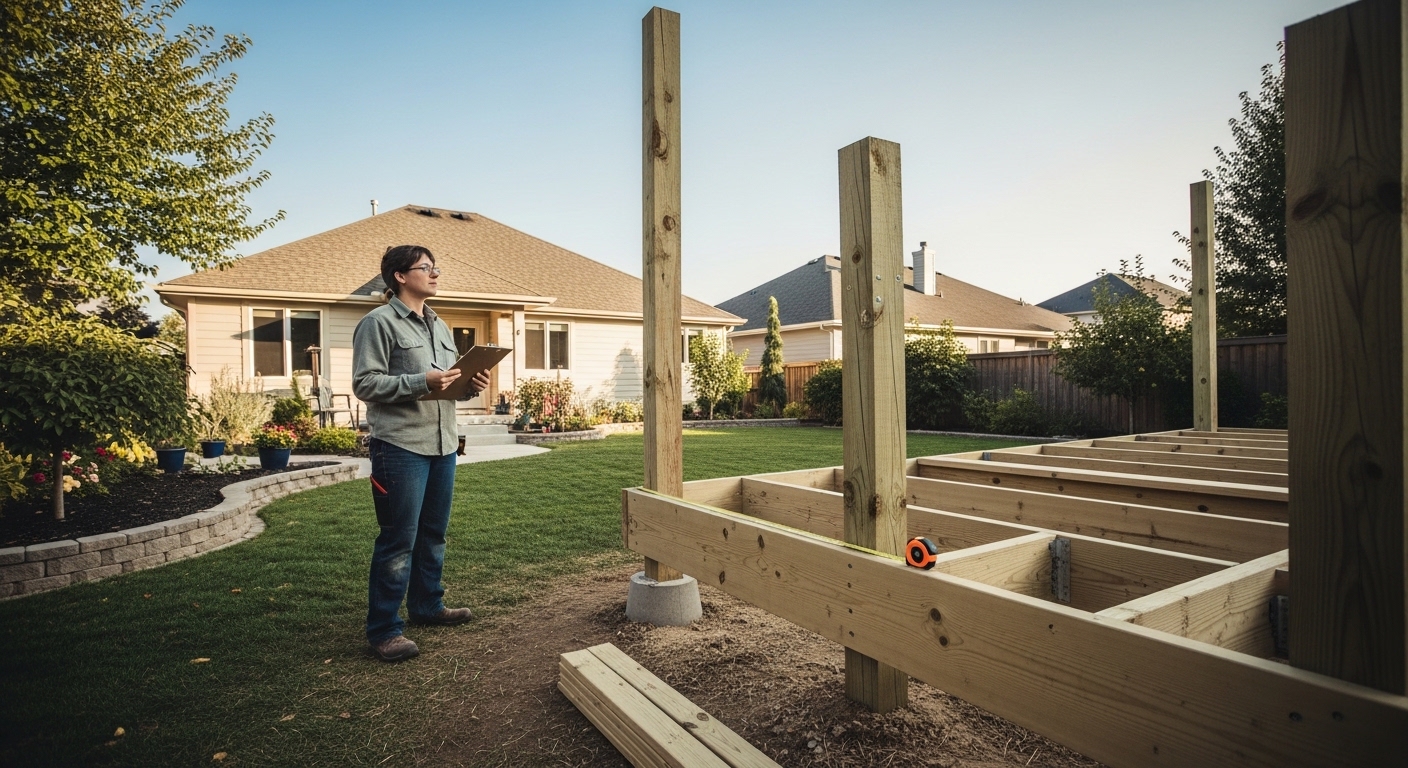
5. Proper Footing and Post Requirements
Harris County soil is… well, it’s basically clay that acts like a sponge. It expands when it’s wet and shrinks when it’s dry. Because of this, the “footings” (the concrete bases your deck sits on) have to be done right.
Permit offices will check your “frost line” depth—though in Texas, we’re more worried about the “stability line.” They want to see that your posts are anchored so the deck doesn’t start leaning like the Tower of Pisa after two years of Texas humidity.
Real-World Scenario: Without a permit inspection, some folks just “set posts in dirt” or use those pre-made concrete blocks. After one bad hurricane season, those decks often start pulling away from the house, creating a massive gap. If you’re already looking into storm damage repair in Texas, the last thing you want is a deck that adds to the list of problems.
6. The “Attached” vs. “Detached” Debate
This is a sneaky one. If your deck touches your house, it’s an addition. If it’s even one inch away and stands on its own four legs, it’s a “detached structure.” The permit requirements for an addition are much more stringent because you’re messing with the structural integrity of your home.
Real-World Scenario: Many homeowners build a “detached” deck just an inch away from the house to avoid some of the heavier “addition” codes. It’s a smart move, but you still need to make sure the gap is flashed properly so water doesn’t rot your house wall.
Comparison Summary: Permit vs. No Permit
| Feature | Usually Needs a Permit | Usually Doesn’t Need One |
| Height | 30″ or higher from grade | Under 30″ (Platform style) |
| Connection | Bolted to the house ledger | Completely free-standing |
| Location | Over easements or utility lines | Within buildable backyard area |
| Size | Larger than 200 sq. ft. | Small landing or “stoop” |
| Roofing | If it has a permanent cover | Open-air slats or umbrellas |
Key Takeaways for Harris County Homeowners
- Height is the Trigger: If you’re high enough to need stairs, you probably need a permit.
- The Paper Trail Matters: Keep your permit records! You’ll need them when you sell your home.
- Safety First: Rules about railings and footings exist because decks fail more often than almost any other part of a house.
- Check the Map: Harris County is huge. Rules in Baytown might vary slightly from home remodeling in The Woodlands.
- When in Doubt, Ask: A 10-minute phone call to the Harris County Engineering Department can save you a $500 fine later.
Wrapping it all up…
Look, I get it. Nobody wants to spend their vacation fund on permit fees and “boring” structural stuff like concrete footings. We want the outdoor kitchen and the comfortable lounge chairs.
But a deck is an investment in your home’s value. Doing it “off the books” might save you a few hundred bucks today, but it could cost you thousands in “fix-it” costs or lost home value tomorrow. Plus, there’s a certain peace of mind that comes with knowing your deck is solid enough to handle a housewarming party without a single creak.
If you’re feeling a bit overwhelmed by the codes—or if you’ve realized your “simple” deck is actually a major exterior remodeling project—don’t sweat it. You don’t have to do the heavy lifting (or the paperwork) alone.
Thinking about upgrading your outdoor space? Whether you need a total deck installation or just a solid repair to get things up to code, we’re here to help. We know the Harris County dirt and the Harris County rules.
Reach out for a free estimate today, and let’s get that dream deck built the right way. No stress, no “oops” moments—just a great place to hang out.