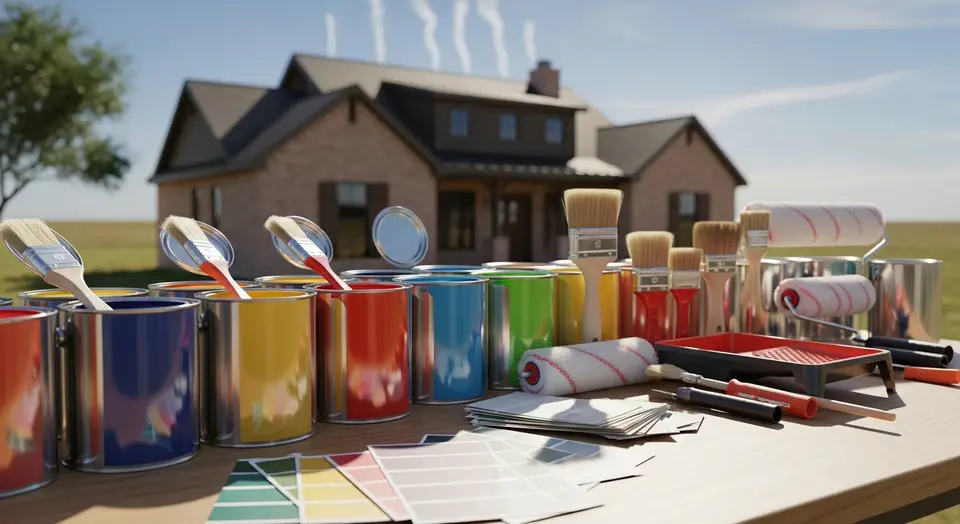
The “Suntan Lotion” Your House Actually Needs
I remember standing in a driveway in Sugar Land a few years back, looking at a home that had been painted just eighteen months prior. From the curb, it looked… okay. But as we got closer, you could see it. The beautiful deep navy trim was already turning a chalky, tired gray. On the south-facing wall, the paint was actually starting to blister, pulling away from the siding like a bad sunburn.
The homeowner was heartbroken. They’d spent thousands on a “pro” job, but they’d made one fatal mistake: they let the contractor use a standard, “off-the-shelf” builder’s grade paint. In most parts of the country, that paint would have lasted a decade. In Texas? It didn’t stand a chance.
Honestly, we don’t just have weather in Texas; we have atmospheric warfare. Between the UV rays that bake your walls at 105°F and the coastal humidity that makes everything feel like a swamp, your house is under constant attack. If you’re planning on refreshing your look this year, you can’t just pick a pretty color. You have to pick a chemistry set that can survive the Lone Star State.
Why Texas is the “Final Boss” of Exterior Paint
Before we get into the specific cans of paint you should be buying, we need to understand what we’re up against. Think of it this way: the sun is a giant bleaching machine, and the humidity is a constant invitation for mold and mildew to take up residence on your siding installation.
The UV Factor
In places like Houston or Pasadena, the UV index regularly hits “extreme” levels. This radiation breaks down the binders in low-quality paint, turning the finish into a fine powder (that’s the “chalking” I mentioned earlier). Once the binder is gone, the color goes with it.
The Thermal Expansion Trap
Texas walls can swing 40 degrees in temperature in a single day. Your house literally grows and shrinks. If your paint isn’t “flexible”—meaning it can’t stretch and contract without cracking—it’s going to develop micro-fissures. Those fissures are like open doors for moisture.
The 2026 Heavy Hitters: Brands That Actually Hold Up
Look, I’m not loyal to a logo; I’m loyal to results. After years of seeing what works and what fails on Texas home remodeling projects, here are the three brands and specific lines that have earned their keep.
1. Sherwin-Williams: Emerald® Rain Refresh™
This is currently the “king of the hill” for Texas homeowners.
- Why it works: It’s formulated with “Self-Cleaning Technology.” When it rains (or when you spray it with a hose), dirt washes right off. In dusty parts of Texas, this is a lifesaver.
- The Heat Shield: It has incredible UV resistance. I’ve seen Emerald jobs that look brand new five years later, even in direct sun.
- The Catch: It is expensive. But honestly, would you rather pay for a premium paint once, or a cheap paint three times?
2. Benjamin Moore: Aura® Exterior
If you are picking a dark color—like a modern charcoal or a deep forest green—this is your go-to.
- Why it works: Their “Color Lock” technology is the real deal. It embeds the pigment inside the resin so it doesn’t wash out or fade nearly as fast as competitors.
- Humidity Defense: It’s exceptionally good at resisting mildew, which is a must if you live anywhere near the coast or in East Texas.
3. Behr: Marquee® Exterior
I know, I know—some pros scoff at “big box” brands. But Marquee has come a long way.
- Why it works: It’s a fantastic mid-range option that offers great “hide” (meaning you need fewer coats).
- Reliability: It creates a very tough, non-stick surface that resists the typical Texas grime.
Expert Insights: The Stuff the Sales Guy Won’t Tell You
I’ve sat through enough manufacturer seminars to know the buzzwords, but here’s the “boots on the ground” truth you need to know:
1. Sheen is a Survival Strategy In Texas, I almost always recommend a “Satin” or “Low-Lustre” finish. “Flat” paint might look sophisticated, but it’s porous. It holds onto dirt and moisture like a sponge. Satin provides just enough “slickness” to help the water bead off without making your house look like a shiny plastic toy.
2. The Primer is 50% of the Battle If you’re painting over old, thirsty wood or masonry, the best paint in the world will fail if the primer is weak. For Texas, you want a high-build, alkali-resistant primer. It seals the surface so the expensive topcoat can do its job.
3. Temperature Windows Matter You might be tempted to paint in July because the sun is out. Don’t. If the surface temperature of your siding is over 90°F, the paint will dry too fast, preventing it from bonding correctly. You’ll end up with “flash drying” and peeling within a year. Aim for those sweet spots in spring or fall.
Practical Application: Your Buying Guide
If you’re heading to the store this weekend, don’t just walk in and ask for “tan.” Use this checklist:
- Check the VOCs: Lower VOCs are better for the environment, but sometimes higher-VOC specialized “extreme” paints are necessary for historic Texas homes with old oil-based layers.
- Ask about “VinylSafe” Colors: If you have vinyl siding and want a dark color, you must use VinylSafe technology. Standard dark paint will absorb so much heat it will literally warp your siding installation.
- The “Sample” Rule: Buy a quart first. Paint a 2×2 square on the South side of your house. Watch it for 48 hours. Texas light is so bright it “washes out” colors—that “medium gray” might look like stark white at noon.
FAQ: Common Texas Painting Questions
Q: Is it worth paying $100+ per gallon? Honestly? Yes. In our climate, a $40 gallon of paint is a 3-year solution. A $100 gallon is a 10-year solution. The labor is the most expensive part of the job; don’t waste it on cheap materials.
Q: Can I paint my brick? You can, but you shouldn’t use standard exterior paint. Brick needs to “breathe.” Look for specialized mineral paints or “silicate” coatings. If you trap moisture inside the brick with standard latex, it can cause structural issues or “spalling” later.
Q: How often should I repaint in Texas? Even with the best paint, keep an eye on things every 5-7 years. If you notice the gloss is gone, you might just need a good professional cleaning rather than a full repaint.
Bringing it All Home
At the end of the day, your home is your sanctuary. It’s probably your biggest investment, too. In Texas, that investment is constantly being baked, steamed, and wind-whipped. Choosing a high-end paint brand isn’t just about “curb appeal”—it’s about building a defensive shield around your family’s space.
I think back to that house in Sugar Land. We ended up stripping it down, doing some much-needed roof repair, and repainting it with a high-end reflective coating. Three years later, the colors are still sharp, the AC is running less, and the owner isn’t worried about peeling.
If you’re feeling overwhelmed by the options or you’ve realized your siding needs more than just a fresh coat of paint—maybe it’s time for a full refresh—we’re here to help. Whether you’re in Conroe or Galveston, we know exactly what it takes to make a Texas home last.
Give us a shout or request a quote today. Let’s make sure your next paint job is your last one for a long, long time.
Stay cool, and keep those brushes moving.