
What Happens If You Never Clean Your Gutters in Texas
Let’s be real for a second. Nobody wakes up on a Saturday morning in Houston or Dallas and thinks, “You know what sounds like a blast? Climbing a shaky ladder to scoop out handfuls of wet, stinky sludge from my gutters.” It’s a dirty, thankless job. And honestly? Most of the time, we just forget the gutters even exist until a massive thunderstorm turns the front porch into a splash pad.
But here’s the thing—Texas weather is a special kind of aggressive. We go from six months of baking sun to sudden, violent “frog-strangler” downpours that drop three inches of rain in an hour. When that water hits your roof, it needs a clear exit strategy. If your gutters are packed with oak tassels, pine needles, or that weird shingle grit, that water isn’t going anywhere.
And that’s when things get expensive. Really expensive. I’ve seen homeowners ignore their gutters for a few seasons only to end up with five-figure repair bills that had absolutely nothing to do with the roof itself. If you’ve been putting off this chore, let me walk you through what’s actually happening up there while you’re not looking.
1. The Foundation “Death Spiral”
Most people think gutters are there to protect the roof. They’re actually there to protect your foundation. In Texas, we have “expansive” clay soil. When it gets wet, it swells; when it dries, it shrinks. Your house is basically sitting on a giant, moody sponge.
When gutters clog, water overflows and pools directly at the base of your home. Instead of the soil getting a nice, even drink, it gets a concentrated flood in one spot. This causes the soil to push against your foundation unevenly. Eventually? Cracks. Doors that won’t shut. Windows that stick.
A Real-World Moment: I remember a client in San Antonio who thought a little gutter overflow was “no big deal.” Two years of ignoring it, and he had a crack in his slab wide enough to fit a quarter. He saved $100 on gutter cleaning and spent $12,000 on foundation piers. Not a great trade.
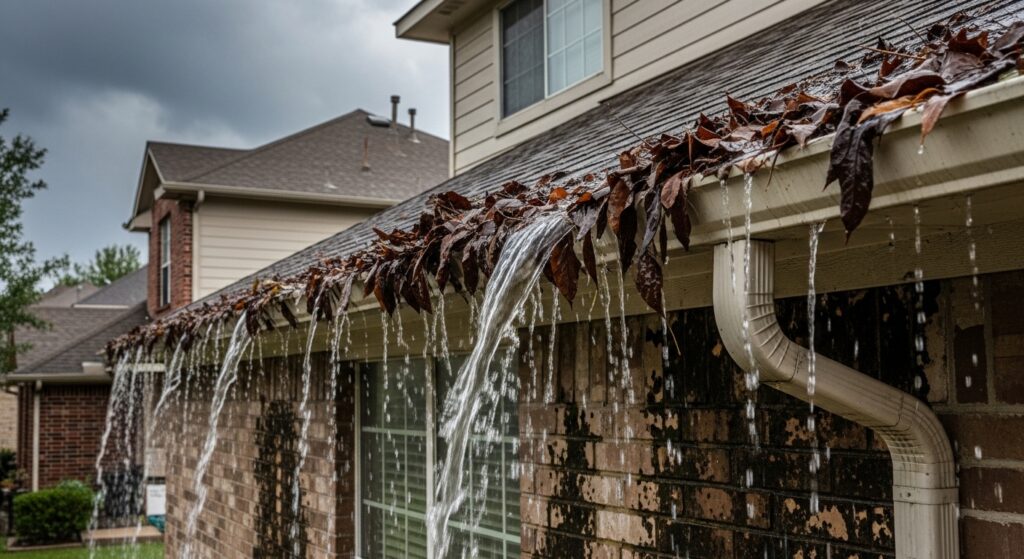
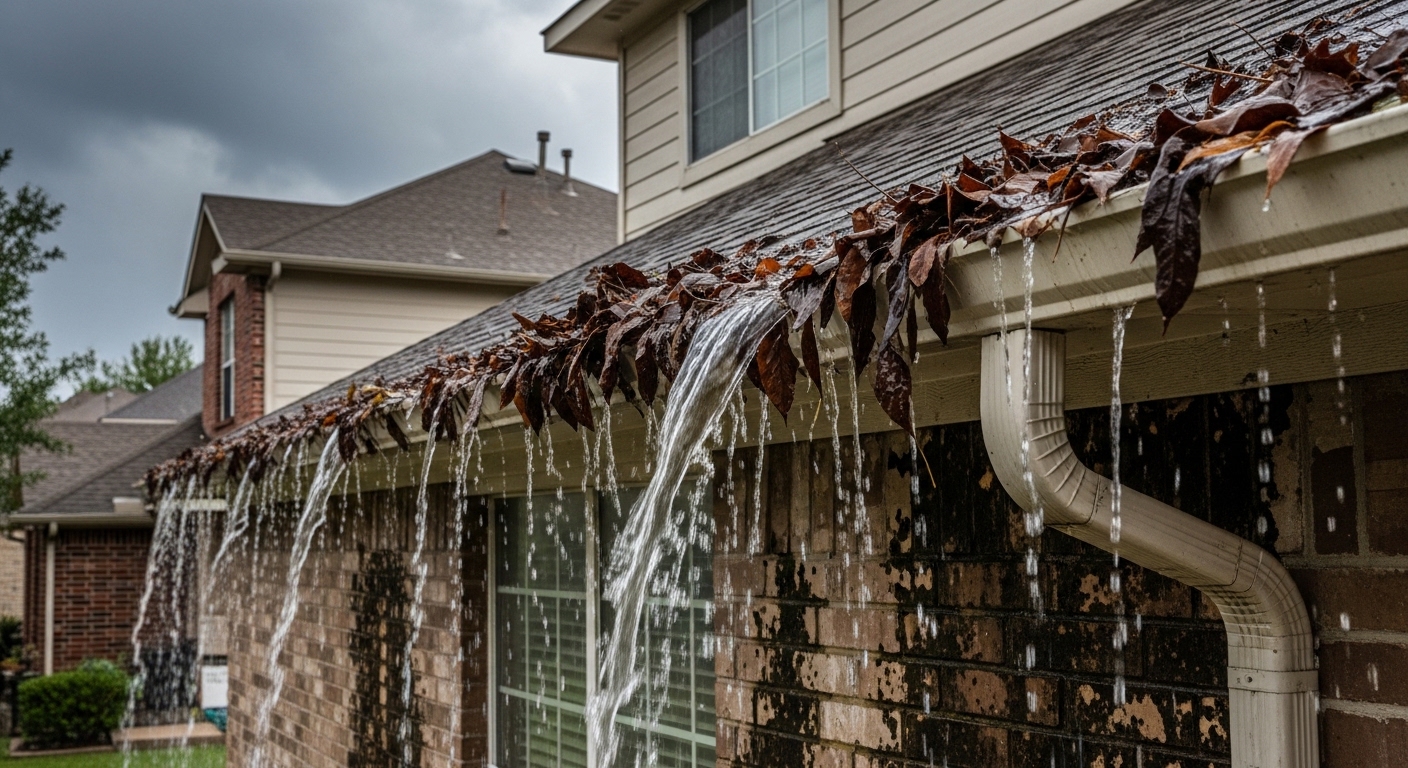
Quick Insight: If you see “tiger stripes” (dark streaks) on the outside of your gutters, it means they’re already overflowing. Your foundation is likely taking a beating.
2. The Wood Rot “Hidden Creep”
Water doesn’t just fall straight down when a gutter is clogged. It backs up. It sits against your fascia boards (that’s the wood behind the gutter) and wicks up into your roof decking.
Because of the Texas humidity, that trapped moisture never really dries out. It just sits there and stews. Before you know it, the wood starts to soften. Mold moves in. Eventually, the hardware holding your gutters up just… pulls right out because the wood is too mushy to hold a screw.
A Real-World Moment: I’ve seen entire gutter systems literally fall off a house because the fascia board behind them had turned into the consistency of wet cardboard. At that point, you aren’t just cleaning gutters—you’re rebuilding the edge of your roof.
Quick Insight: Check the wood behind your gutters for dark spots or peeling paint. If the paint is bubbling, there’s water trapped inside that wood.
3. The “Pest Hotel” in the Sky
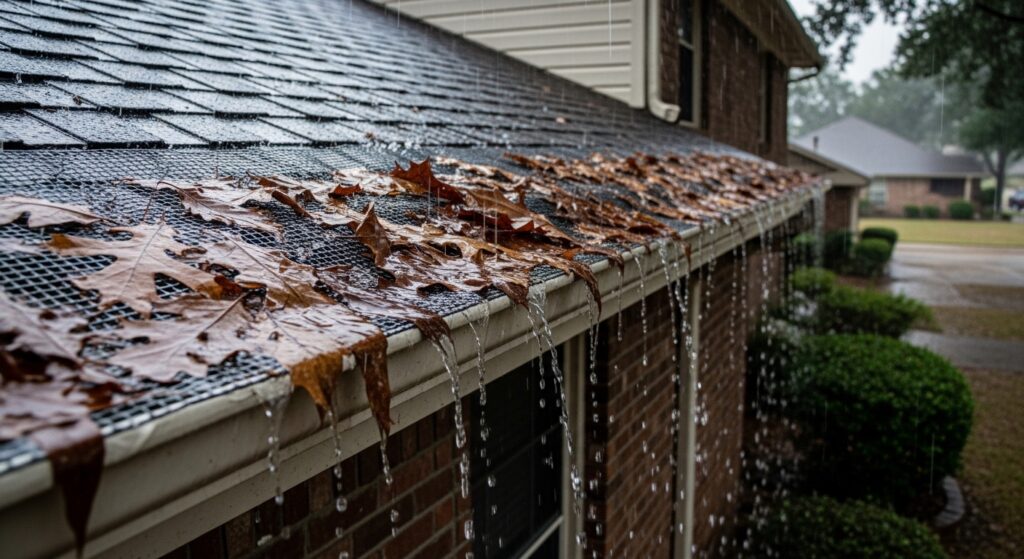
You know what loves a thick, wet mat of rotting leaves and stagnant water? Everything you don’t want in your house. In Texas, clogged gutters are basically a five-star resort for mosquitoes, roaches, and wood-destroying ants.
Even worse? Squirrels and rats. They love the easy access to softened wood. If your gutters are full of debris, it provides the perfect “nesting” material right next to a potential entrance into your attic. Once they chew their way in, you’ve got a whole new set of problems.
A Real-World Moment: I once helped a homeowner who couldn’t figure out why he had a massive mosquito problem on his patio even though he had no standing water in his yard. We looked up—his gutters were so packed with debris that they had tiny, thriving ecosystems (and thousands of larvae) ten feet above his head.
Quick Insight: If you see birds or squirrels spending a lot of time on your roofline, they aren’t just enjoying the view. They’re likely scavenging in your gutter “garden.”
4. Shingle Damage and “Ice Dams” (Yes, even in Texas)
Wait, ice dams in Texas? Look, we all remember the 2021 freeze. When water can’t drain, it freezes in the gutter. That ice expands, gets under your shingles, and pries them up.
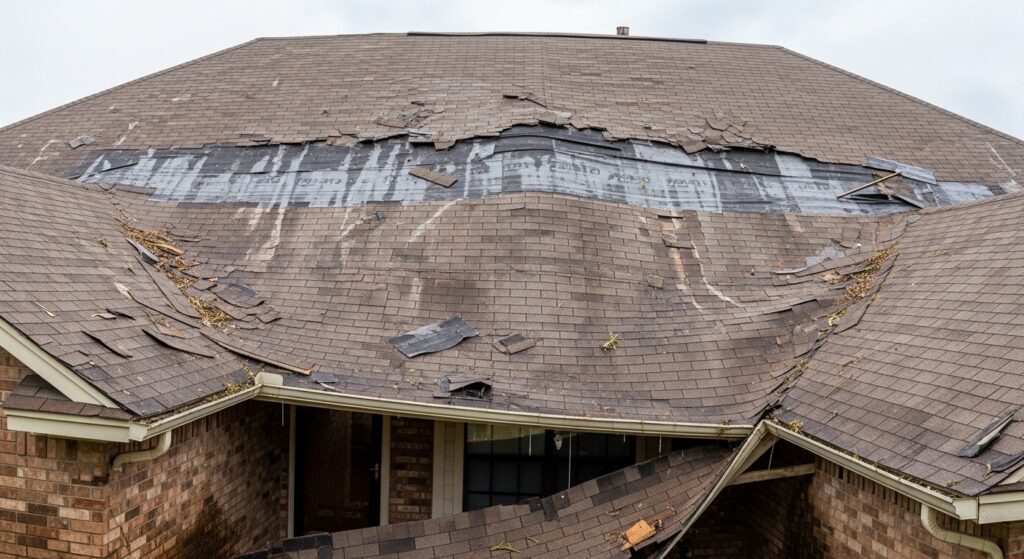
But even without the ice, sitting water is bad news for shingles. Asphalt shingles are meant to shed water, not soak in it. When water backs up under the edges because the gutter is full, it rots the “starter strip” and the underlying felt. This leads to leaks that you won’t even notice until you see a yellow circle on your bedroom ceiling.
A Real-World Moment: Many people think a new roof solves everything, but even the best roofing materials for the Houston climate will fail prematurely if they’re constantly submerged in gutter-swamp water.
Quick Insight: If you see granules (the “sand” from shingles) filling up your gutters, your roof is aging faster than it should because it’s staying wet too long.
5. Landscaping Destruction
You spend a lot of money and time on your flower beds and those expensive Japanese Maples. Clogged gutters act like a pressure washer during a storm.
Instead of water being channeled through a downspout and away from the house, it cascades over the side in a heavy sheet. This “waterfall effect” blasts away mulch, drowns delicate plants, and carves ugly trenches in your lawn. It can even lead to driveway sinking if the water undermines the soil beneath the concrete.
A Real-World Moment: I’ve seen beautifully manicured lawns in Austin ruined in a single season because the “overflow” carved a literal canyon through the middle of a prized flower bed.
Quick Insight: If your mulch is constantly ending up on your sidewalk after a rain, your gutters are the prime suspect.
Summary Table: The Cost of Neglect
| The Problem | Time to Develop | Estimated Repair Cost |
| Mosquito/Pest Infestation | 2–4 Weeks | $200 – $500 (Exterminator) |
| Landscape Erosion | 1–2 Storms | $500 – $2,000 |
| Rotting Fascia/Wood | 1–2 Seasons | $1,500 – $4,000 |
| Foundation Cracks | 2–5 Years | $5,000 – $25,000+ |
Key Takeaways
- Gutters protect the ground, not just the sky: Their main job is keeping your foundation stable.
- Clogs are a slow burn: You won’t notice the damage today, but you’ll definitely notice the bill next year.
- Texas debris is different: Between the oak tassels in the spring and the cedar “pollen” in the fall, our gutters need more attention than homes in other states.
- Cleaning is cheaper than replacing: A $150 cleaning twice a year prevents a $15,000 foundation pier job.
Conclusion: Don’t Let It Sit
Look, I get it. Life gets busy. The kids have soccer, the job is demanding, and the last thing you want to do is deal with the gutters. But if you’re a homeowner in Texas, ignoring them is a gamble where the house always loses.
Think of gutter cleaning like changing the oil in your car. It’s boring, a little annoying, and you don’t “feel” the difference immediately—but it’s the only thing keeping the whole machine from exploding.
If you aren’t comfortable on a ladder (and honestly, most people shouldn’t be), just hire a pro. It’s one of the few home maintenance tasks that has a nearly 100x return on investment when you consider the foundation damage it prevents.
Ready to stop worrying about the next big rain?
If you suspect your system is already damaged or you’re tired of the “waterfall” over your front door, check out our gutter and downspout services in Texas. We can help you figure out if you just need a good cleaning or if it’s time for a more permanent solution like gutter guards.
Trust me, your foundation (and your wallet) will thank you. Now, go enjoy your Saturday—just maybe keep an eye on those eaves the next time it rains.