
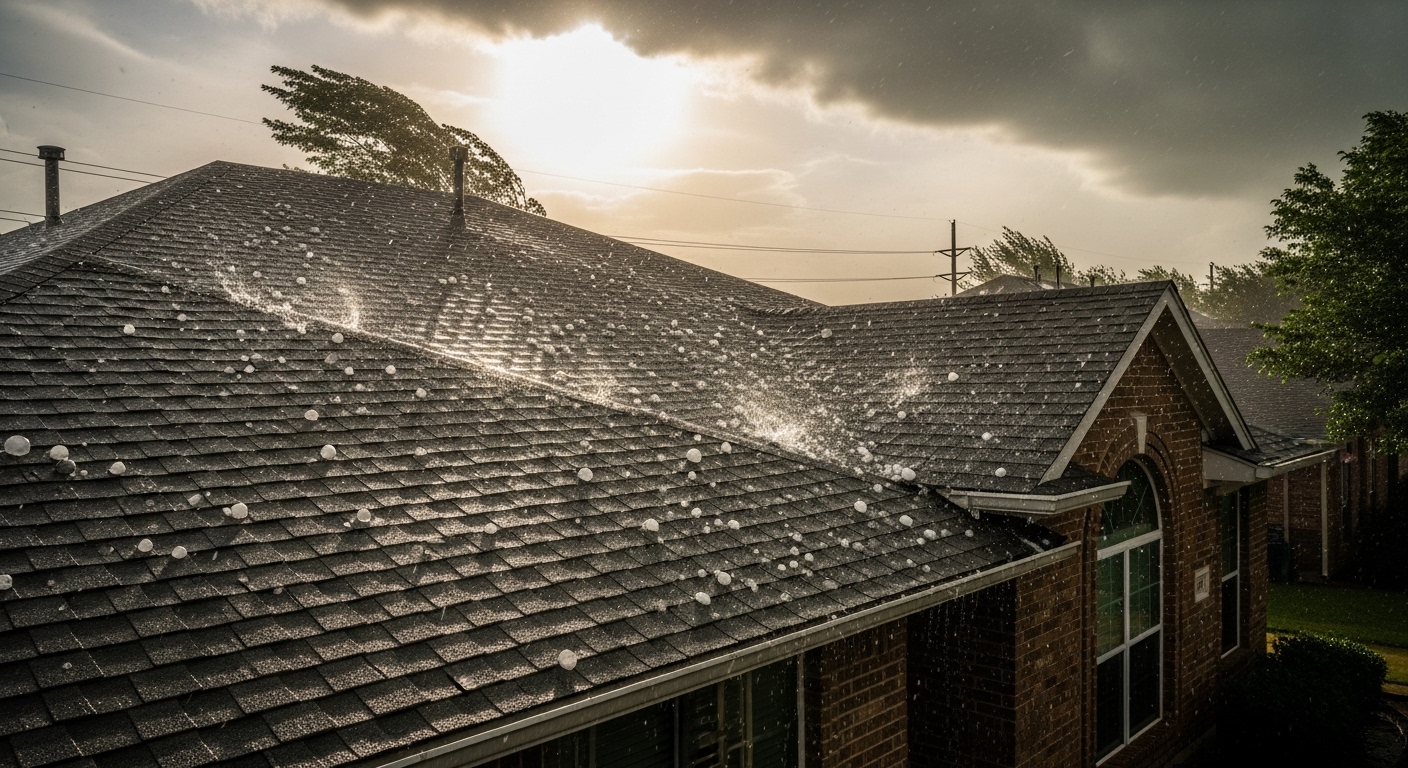
If you’ve lived in Texas for more than a single spring season, you know the sound. It starts as a distant rumble, then turns into a frantic tapping on the windows, and finally, it sounds like someone is dumping a bucket of golf balls onto your roof. Hail. It’s the unofficial state sport of Texas, except nobody wins and the prizes are just high insurance deductibles and a messy yard.
I’ve sat across many kitchen tables from homeowners who are staring at a “hail-totaled” roof, wondering how they’re going to pay for the next one. That’s usually when the topic of impact-resistant shingles comes up. People hear they’re the “superhero” of shingles and—more importantly—that they might actually make your insurance company stop taking so much of your hard-earned money every month.
But does it actually work that way? Or is it just a clever marketing pitch from roofing companies? Honestly, it’s a bit of both, and the “Texas truth” is a little more nuanced than a simple yes or no. Let’s walk through what you actually need to know before you sign that contract.
1. The Magic of the “Class 4” Rating
When people talk about impact-resistant shingles, they’re usually talking about “Class 4” shingles. This isn’t just a fancy name; it’s a specific grade given after a pretty brutal test. Imagine a laboratory where scientists drop a two-inch steel ball from twenty feet onto the same spot of a shingle twice. If it doesn’t crack or tear? It gets the Class 4 badge.
Most standard shingles are “Class 1” or “Class 2,” which is basically like wearing a t-shirt in a hail storm. Class 4 shingles are more like a heavy-duty leather jacket. They use specialized polymers (usually a rubber-like material called SBS) that allow the shingle to flex and bounce back rather than shattering when a hailstone hits it.
A Real-World Moment: I remember a client in Plano who installed these right before a nasty storm rolled through. Her neighbor’s standard roof looked like someone had taken a hammer to it. Her roof? Barely a scratch. But—and here is the catch—just because the roof survived doesn’t mean the insurance company automatically sends you a thank-you check. You have to prove it to them.
Quick Insight: Look for shingles labeled “UL 2218 Class 4.” If it doesn’t have that specific certification, your insurance agent probably won’t even look at your discount request.
2. The Texas Insurance Discount (The Part You Care About)
Here’s the good news: Texas law actually encourages insurance companies to offer discounts for hail-resistant roofs. Most major carriers in the Lone Star State offer somewhere between a 10% and 35% discount on the homeowners’ insurance premium (specifically the wind/hail portion).
But don’t get too excited yet. This isn’t 35% off your entire bill. It’s off the portion of the bill that covers wind and hail damage. Still, in places like Dallas, Fort Worth, or Amarillo, where hail is basically a weekly guest, that portion of your bill is huge. Over five to seven years, that discount often pays for the extra cost of the shingles themselves.
A Real-World Moment: I’ve seen homeowners save $400 to $600 a year on their premiums. Over the life of a 20-year roof, that’s ten grand. That’s not pocket change; that’s a used car or a very nice vacation.
Quick Insight: Before you buy, call your specific agent. Ask them for a “what-if” quote. Say, “Hey, if I put Class 4 shingles on, exactly how much will my premium drop?” Get it in writing. Don’t guess.
3. The “Cosmetic Damage” Waiver Trap
This is the part that some roofing sales reps “forget” to mention. To give you that juicy discount, some insurance companies will ask you to sign a “Cosmetic Damage Exclusion.” This essentially says: “We’ll give you the discount, but we won’t pay to replace your roof if the hail only makes it look ugly without actually causing it to leak.”
Think about that for a second. If a storm hits and your beautiful new roof is covered in small dents that don’t technically “compromise the integrity,” the insurance company won’t pay a dime to fix it. To some people, that’s a dealbreaker. To others, they don’t care what the roof looks like as long as it stays dry inside.
A Real-World Moment: I had a friend who took the discount and signed the waiver. A year later, a storm peppered his roof. It looked “dimpled” but was functionally fine. He tried to sell his house, and the buyer’s inspector flagged the roof. Because of the waiver, he had to pay for the repairs out of his own pocket to close the sale.
Quick Insight: Read the fine print. If your policy has a cosmetic damage exclusion, weigh the premium savings against your potential future resale value.
4. Why Material Choice Matters (It’s Not All Asphalt)
While most people think of asphalt shingles, you can also get impact resistance from metal, slate, or synthetic tiles. If you’re looking at the best roofing materials for the Texas climate, you’ll see that metal often carries a Class 4 rating naturally.
Metal is the “overachiever” here. Not only does it get the insurance discount, but it also reflects heat, which is a massive win for your AC bill in July. However, if you’re in a neighborhood with a strict HOA, they might scoff at a metal roof, which brings us back to those Class 4 asphalt shingles that look just like the “normal” ones.
A Real-World Moment: A family in Austin switched to a synthetic Class 4 slate. It cost a fortune upfront, but between the insurance discount and the fact that it’ll likely outlive them, they’re thrilled. It’s about playing the long game.
Quick Insight: If you’re planning on staying in your home for 15+ years, consider the “premium” materials. If you’re moving in two years? Stick to high-end asphalt.
5. The “Maintenance-Free” Myth
Look, I love Class 4 shingles, but they aren’t bulletproof. They are resistant, not proof. If a hailstone the size of a grapefruit falls from the sky, I don’t care what kind of shingle you have—it’s going to leave a mark.
The real value isn’t that you’ll never have a claim; it’s that you won’t have a claim for the small stuff. Most Texas roofs are killed by 1-inch hail. Class 4 shingles laugh at 1-inch hail. This keeps you from having to find $5,000 for your deductible every three years, which—honestly—is the real “insurance” benefit.
A Real-World Moment: I know a guy who has had the same Class 4 roof through four major storms that totaled every other house on his block. He’s the only one who didn’t have to deal with contractors and adjusters for a decade. That peace of mind? You can’t put a price on that.
Quick Insight: Even with great shingles, get a professional inspection after any major storm. Small cracks can grow over time, and you want to catch them while they’re still “small” problems.
Summary Table: Standard vs. Class 4 Shingles
| Feature | Standard Shingles (Class 1-2) | Impact-Resistant (Class 4) |
| Upfront Cost | Lower | 10% – 25% Higher |
| Hail Resistance | Poor (Brittle) | Excellent (Flexible/SBS) |
| Insurance Discount | Usually None | 10% – 35% in Texas |
| Lifespan in Texas | 12-15 Years | 20-25+ Years |
| Best For | Budget-conscious / Selling soon | Forever homes / High-hail areas |
Key Takeaways
- Yes, they lower premiums: Most Texas insurers offer significant discounts for UL 2218 Class 4 certified roofs.
- The “Return on Investment” is real: The extra cost of the shingles usually pays for itself in 5-7 years through insurance savings.
- Watch for Waivers: Be careful of “cosmetic damage” exclusions that might save you money now but cost you during a home sale later.
- Durability over Beauty: The real win is avoiding the “deductible dance” every time it hails.
- Verify First: Always get a quote from your insurance agent before you commit to the upgrade.
Conclusion: Is It Worth It?
Look, I’ll be straight with you: If I were replacing my own roof in Texas today, I wouldn’t even consider anything less than a Class 4 shingle. Between the volatile weather and the way insurance rates are skyrocketing lately, you need every advantage you can get.
Think of it like buying a high-quality pair of tires. Sure, the cheap ones get you down the road, but the good ones keep you on the road when things get slippery. Impact-resistant shingles are exactly that—they’re an investment in not having to worry about the sky falling every time the clouds turn that weird shade of green.
Your Next Step:
Don’t just take my word for it. Call your insurance provider this afternoon. Ask them, “If I install a Class 4 impact-resistant roof, what is the exact percentage discount I get on my annual premium?” Once you have that number, you can do the math and see just how fast that “expensive” roof pays you back.
Trust me, your future self—the one not panicking during the next hailstorm—will thank you.
Curious about other ways to protect your Texas home? Check out our deep dive on the best roofing materials for the Houston climate to see which options stand up best to the heat and humidity.