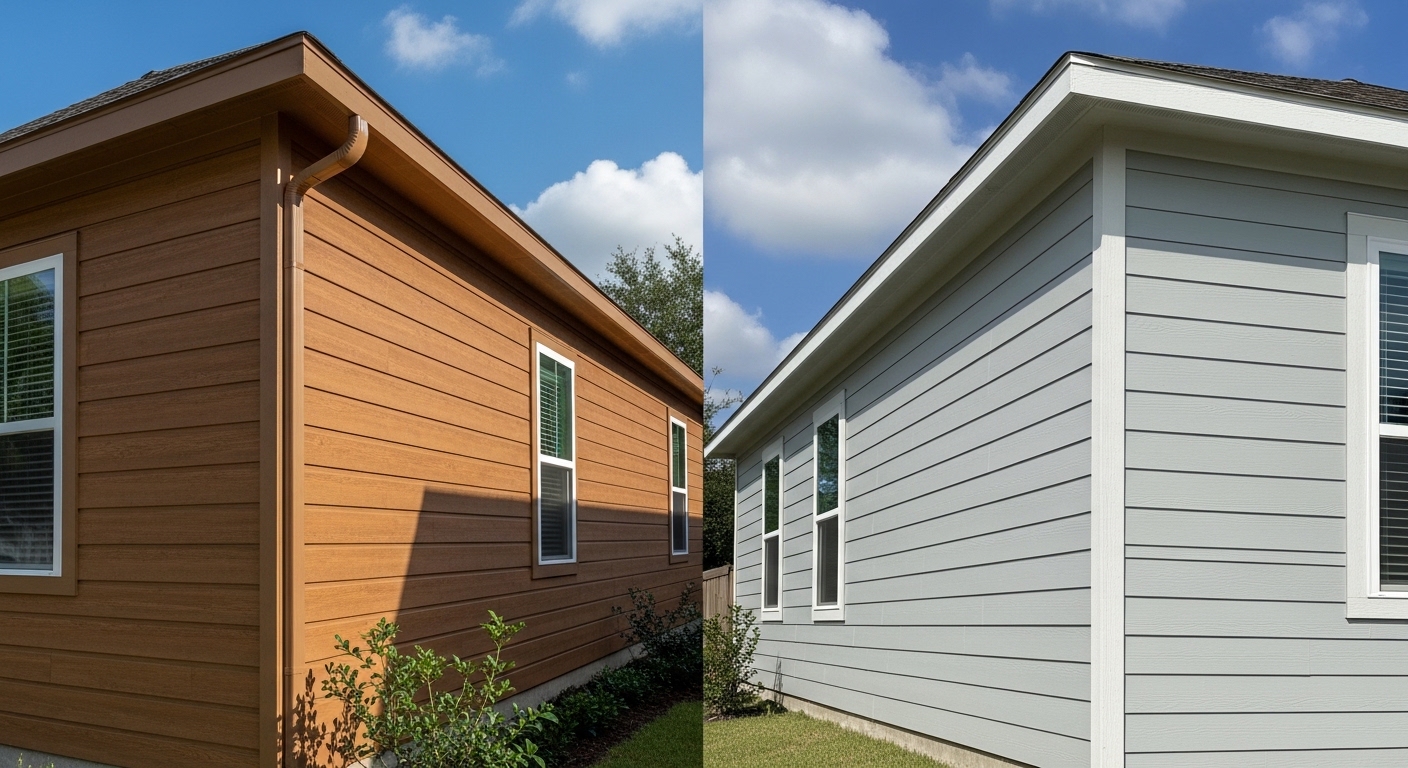
LP SmartSide vs. James Hardie: The Great Houston Siding Showdown
If you’ve spent more than five minutes researching home siding in Texas, you’ve hit a wall. Or rather, two very specific walls: LP SmartSide vs. James Hardie. It’s the Coke vs. Pepsi of the exterior world.
Look, I get it. You’re standing in your driveway, staring at that old, peeling siding—maybe it’s that vintage T1-11 that’s seen better days—and you’re realizing this isn’t just about making the house look pretty. It’s about protecting your biggest investment from Houston’s unique brand of meteorological chaos. We’re talking about humidity thick enough to swim in, hail that sounds like a drum solo on your roof, and termites that view your house as a five-star buffet.
Choosing between these two is stressful because both are actually really good. But they’re made of completely different stuff, and they handle our “Bayou City” climate in very different ways. I’ve seen homeowners go with one because their brother-in-law liked it, only to regret it three years later when they realized it wasn’t the right fit for their specific lot or budget.
Let’s skip the corporate brochures and have a real talk about which one actually belongs on your home. If you’re already leaning toward a refresh, you might want to look at what siding installation in Texas actually looks like in practice.
The Contenders: A Quick Look at the Rivals
Before we get into the nitty-gritty, let’s define what we’re actually comparing. These aren’t just different brands; they’re different technologies.
Option 1: James Hardie (Fiber Cement)
This is the heavyweight champion. It’s made from a mixture of cement, sand, and cellulose fibers. It’s essentially a thin sheet of concrete that looks like wood. It’s been the gold standard for decades because, well, it’s hard to beat concrete when it comes to durability.
Option 2: LP SmartSide (Engineered Wood)
This is the innovative challenger. It’s made of wood strands treated with zinc borate (to kill bugs and rot) and bonded with heavy-duty resins. It’s much tougher than natural wood but lighter and easier to work with than fiber cement.
Detailed Comparison: What’s Under the Hood?
James Hardie: The Concrete Shield
When I think of James Hardie, I think of fire protection. Because it’s fiber cement, it’s non-combustible. That’s a huge plus in many neighborhoods.
- Pros: It’s practically invincible to termites and fire. It doesn’t rot. It holds paint incredibly well. If you go with their “ColorPlus” technology, the finish can last fifteen years without a touch-up.
- Cons: It’s brittle. If a heavy hailstone hits it just right, or if a rogue lawnmower rock strikes it, it can crack. It’s also incredibly heavy and produces silica dust when cut, which makes installation a specialized (and more expensive) job.
- Best Use Case: Homes in high-density areas where fire safety is a priority, or for homeowners who want a “set it and forget it” masonry feel.
LP SmartSide: The High-Tech Wood
Here’s the thing about LP SmartSide: it’s surprisingly tough. People hear “wood” and they think of rot, but the SmartGuard process is legit. It handles impact way better than Hardie.
- Pros: It comes in 16-foot lengths (Hardie is 12), which means fewer seams on your house. It’s much more impact-resistant—if your kids are constantly hitting the house with baseballs, this is your winner. It’s also easier to install, which often reflects in lower labor costs.
- Cons: At the end of the day, it’s still a wood-based product. If it’s not installed perfectly—meaning every cut edge is primed and sealed—moisture can find its way in over a decade. It’s also combustible, though it has decent fire ratings.
- Best Use Case: Large homes where you want fewer seams, or areas prone to heavy hail and physical impact.
Side-by-Side: The Houston Scorecard
| Feature | James Hardie | LP SmartSide |
| Material | Fiber Cement (Concrete-like) | Engineered Wood Strands |
| Durability | High (but can crack/chip) | High (superior impact resistance) |
| Moisture Resistance | Excellent | Very Good (requires sealed edges) |
| Termite/Pest Proof | Naturally immune | Treated with Zinc Borate |
| Fire Rating | Non-Combustible | Combustible (Treated) |
| Installation Cost | Generally Higher | Generally Lower |
| Standard Length | 12 Feet | 16 Feet |
Expert Recommendations: My Honest Take
Honestly, I’ve installed both on homes from Pasadena to Conroe, and here is what I’ve learned from watching them age:
Go with James Hardie if…
You want the ultimate peace of mind regarding fire and pests. If you live in an area where houses are close together, that non-combustible rating is more than just a stat; it’s a safety feature. It’s also the better choice if you plan on never, ever moving and want a product that is essentially permanent masonry.
Go with LP SmartSide if…
You hate seams. Those extra four feet of length make a huge visual difference on a long wall. Also, if you’re worried about the occasional Texas hailstorm, LP is the undisputed king of impact. I’ve seen LP take a beating that would leave Hardie looking like a jigsaw puzzle.
If you’re doing a full exterior remodeling in Texas, LP often allows your budget to stretch a bit further because the labor is less intensive.
The Decision Framework: Which One for Your Home?
Still torn? Ask yourself these three questions:
- What’s your “Impact Risk”? Do you have big trees that drop heavy branches? Do your kids play sports in the yard? If yes, look closer at LP SmartSide.
- How close are your neighbors? If your neighbor’s grill is three feet from your siding, the fire-resistance of James Hardie is a massive “Pro.”
- What’s the budget for labor? If the material costs are similar, the labor for Hardie will almost always be higher because of the weight and the specialized cutting tools required.
FAQ: The Stuff People Usually Ask Me
“Does LP SmartSide rot in Houston humidity?”
Not if it’s installed right. The resin and zinc borate treatments are specifically designed to stop fungi and rot. The only risk is if an installer leaves a “raw” cut edge exposed to standing water.
“Is James Hardie waterproof?”
It’s moisture-resistant, but it is porous. It doesn’t rot, but it can absorb water if it’s sitting in it (like if it’s touching the ground). This is why we always leave a 1-2 inch gap between the siding and the roofline or grade.
“Which one looks more like real wood?”
In my opinion? LP SmartSide. Because it’s made of actual wood fibers, the grain pattern looks a bit more “authentic.” Hardie looks great, but up close, you can tell it’s a manufactured masonry product.
Conclusion & Next Step
Choosing between LP SmartSide vs. James Hardie isn’t about finding the “better” product; it’s about finding the one that matches your home’s reality. If you want the “tank” of the siding world, go Hardie. If you want the high-tech, impact-resistant “athlete,” go LP.
Whatever you choose, remember that the best siding in the world will fail if it’s nailed up poorly. We’ve spent years perfecting the art of the “Houston Install”—making sure those gaps are right, the flashing is perfect, and your foundation is protected.
Ready to see the difference in person?
We’d love to bring out some samples so you can actually feel the weight of fiber cement versus the flex of engineered wood. You can request a quote today, and we’ll help you figure out which one is the right “skin” for your home.
Would you like me to look up the specific warranty requirements for both manufacturers to see which one offers better long-term protection for your specific zip code?