
The “Tiny Square” Terror: Picking a Color You’ll Live With for a Decade
Have you ever stood in the paint aisle of a hardware store, staring at five different shades of “Greige,” feeling like your brain is slowly melting? You’re not alone. Picking an exterior paint color is a high-stakes game. Unlike a throw pillow or even a kitchen wall, you can’t exactly “hide” a mistake on the outside of your house. It’s out there for the whole neighborhood—and the brutal Texas sun—to see.
Honestly, it’s about more than just what looks pretty. In Texas, our climate is a major player in this decision. A color that looks sophisticated in a magazine from the Pacific Northwest might look like a neon sign under our 100-degree August sun. Or worse, it might absorb so much heat that your AC unit starts begging for mercy.
If you’re feeling a bit paralyzed by all those little paper swatches, take a breath. We’re going to walk through the five big things you need to consider to make sure you love your home’s new look. Think of this as a strategy session over coffee—minus the overwhelming fluorescent lights of the paint aisle.
1. Factor in the “Texas Heat Index”
In some parts of the world, paint color is purely about aesthetics. In Texas, it’s about thermodynamics. Dark colors—think deep charcoals, navy blues, or forest greens—are stunning, but they are also giant heat sponges. They absorb UV rays, which can actually cause your siding installation to expand and contract more aggressively, potentially shortening its lifespan.
Light colors, on the other hand, reflect the sun. Whites, creams, and light tans act like a summer linen suit for your house. They keep the surface temperature of your walls lower, which can actually help your energy bills. And look, I’m not saying you can’t go dark, but you need to be aware of the “heat tax” that comes with it.
The “Real World” Scenario: I remember a homeowner in Sugar Land who went with a beautiful, trendy “Midnight Raven” black for their siding. It looked amazing, but by the next summer, their electric bill had jumped 15% because the walls were radiating heat into the house long after the sun went down.
Quick Insight: If you’re dead-set on a dark color, look for paints specifically formulated with “cool roof” or reflective pigment technology. It costs a bit more, but it saves your AC.
2. Work With Your “Unchangeable” Elements
Unless you’re doing a full exterior remodeling, your house already has colors you can’t change. I’m talking about your roof shingles, your brickwork, and your stone accents. Your paint needs to be the “supporting actor” to these permanent features.
If your roof has warm, reddish-brown tones, a cool, blue-gray paint might clash in a way that feels “off,” even if you can’t quite put your finger on why. You want to find the undertones in your brick or stone. Is the mortar gray or tan? Is the stone more orange or more cream? Let those existing materials dictate your palette.
The “Real World” Scenario: Think of your house like an outfit. Your brick is the suit, and the paint is the tie. You wouldn’t wear a brown tie with a black suit (unless you’re really bold), and you shouldn’t put a cool gray paint next to warm, orange “Texas Moss” stone.
Quick Insight: Grab a few bricks or a spare shingle and take them to the paint store with you. Don’t rely on your memory!
3. The HOA (The “Invisible” Designer)
We can’t talk about Texas homes without mentioning the HOA. Most neighborhoods in places like The Woodlands or Pearland have strict guidelines on what colors are allowed. Some will even give you a pre-approved “book” of palettes.
Before you fall in love with a specific shade of Mediterranean Blue, check your bylaws. There is nothing more heartbreaking (or expensive) than finishing a beautiful paint job only to get a “Notice of Violation” letter three days later telling you to paint it back.
The “Real World” Scenario: I’ve seen folks try to “sneak” a slightly brighter trim color past their board, only to find out the HOA has a literal color-matching tool they use during inspections. It’s not worth the stress.
Quick Insight: Submit your color choice for approval before you buy the paint. Even if it’s an “approved” color, getting the sign-off in writing protects you later.
4. Test Under the “High Noon” Sun
Here is the biggest mistake people make: they pick a color based on how it looks inside the store or in the shade of their garage. Texas light is harsh. It’s bright, direct, and it “washes out” colors. A color that looks like a nice, medium beige in the store will often look like a stark, blinding white once it’s on a 20-foot wall in the Houston sun.
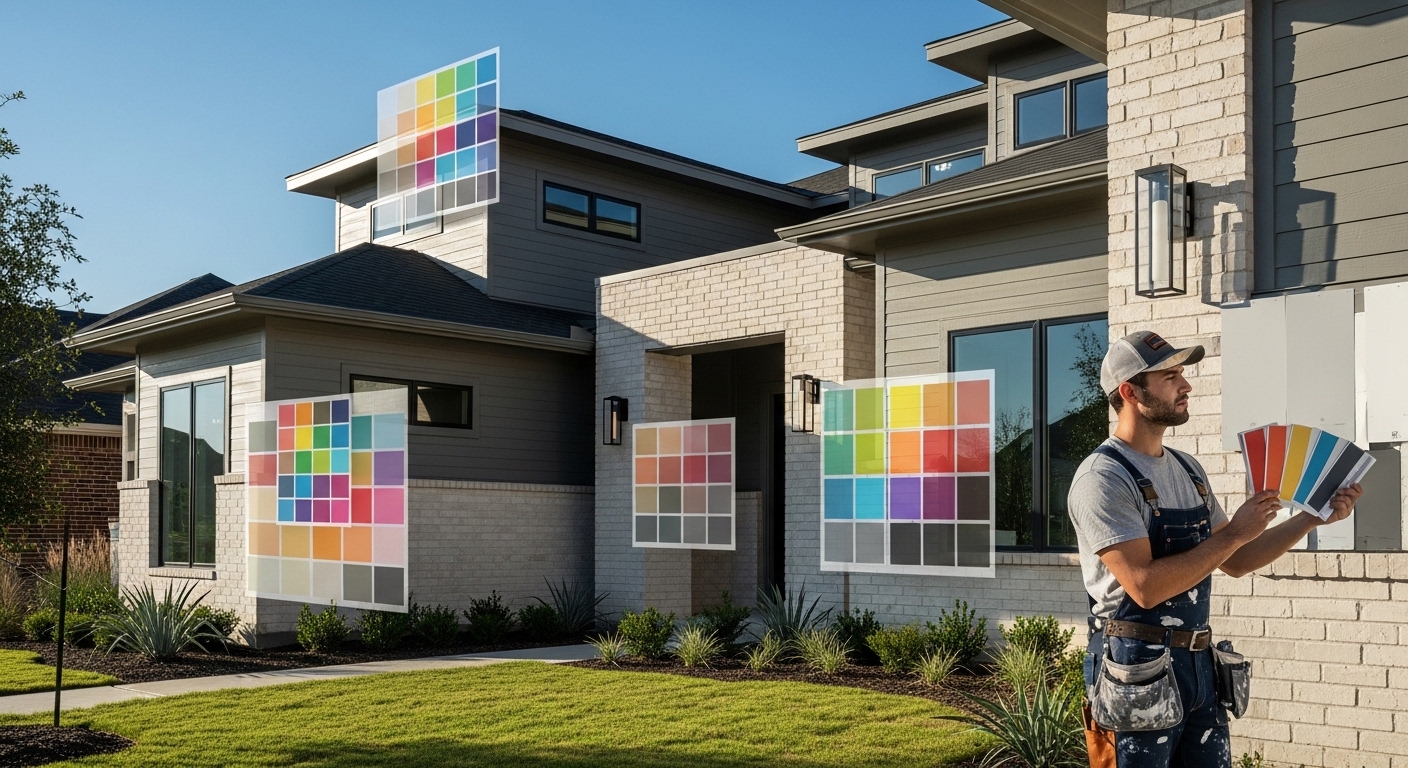
You have to paint “test patches.” Not just one, but patches on different sides of the house. Look at them at 8:00 AM, noon, and 6:00 PM. You’ll be shocked at how much the color shifts. One shade might look perfect in the morning but turn a weirdly “fleshy” pink in the evening light.
The “Real World” Scenario: A friend of mine painted their trim what they thought was a “soft charcoal.” Under the intense Texas sun, the blue undertones came screaming out, and their house ended up looking like it was trimmed in bright periwinkle.
Quick Insight: Paint your samples on a large piece of foam board rather than the house itself. You can move the board around to see how it looks next to the brick, the custom doors, and the grass.
5. Consider the “Neighborhood Context”
Your house doesn’t exist in a vacuum. It sits between two other houses. While you want your home to have personality, you probably don’t want it to be “the house” everyone uses as a landmark because it’s so different.
Look at the three houses to your left and the three to your right. What is the “vibe”? If everyone is using earthy tones and you go with a bright, coastal white, your house is going to feel like it’s floating. You want to be the “best version” of your neighborhood’s style, not a total outlier.
The “Real World” Scenario: Curb appeal is about harmony. When a potential buyer drives down a street, they subconsciously look for a rhythm. If your house breaks that rhythm too jarringly, it can actually hurt your resale value, even if the paint job is high-quality.
Quick Insight: Use the “Three Color Rule”: one main body color, one trim color, and one “pop” color for the front door or shutters. It’s a classic formula that almost always looks professional.
Comparison Table: Light vs. Dark Exterior Colors
| Feature | Light Colors (White, Cream, Tan) | Dark Colors (Navy, Charcoal, Forest) |
| Heat Absorption | Low (Keep house cooler) | High (Increases surface temp) |
| Maintenance | Shows dirt/mildew more easily | Shows dust and “chalking” over time |
| Visual Size | Makes the house look larger | Makes the house look smaller/sturdier |
| Fading Risk | Minimal fading | High risk of fading in Texas sun |
| Trend Longevity | Timeless/Classic | Very trendy/Modern |
Key Takeaways for the Savvy Homeowner
- Go Lighter if you want to save on AC: Light colors reflect the Texas sun; dark colors absorb it.
- Respect the Brick: Your permanent stone and brick should choose the “undertones” of your paint.
- HOA First, Paint Second: Never buy five gallons of paint without a signature from your board.
- Large Samples are Non-Negotiable: A 2-inch swatch is a lie. Paint a 2-foot patch and watch it for 24 hours.
- Harmony wins over Ego: Aim to complement your neighbors’ homes while still standing out with quality.
Ready to Give Your House a New Life?
Look, I know this is a lot to process. Picking a color feels like a permanent decision, but it’s actually an opportunity to fall in love with your home all over again. Whether you’re trying to modernize an old 90s build in Conroe or just freshening up a classic ranch in Galveston, the right color changes everything.
If you’re sitting there looking at your faded siding or peeling trim and wondering where to start, you don’t have to do it alone. We’ve seen a thousand different color combinations across Texas, and we know what stands up to the weather and what doesn’t.
If you want an expert opinion—or if you’ve realized that the “hidden” problem isn’t just the paint, but maybe some roof repairs or old windows—we’re here to help. Request a quote or just give us a shout. Let’s make your home the one that everyone stops to admire on their evening walk.
Stay inspired, and happy painting!